Protecting brand image through AI-assisted quality control of luxury goods
Published on
by
Scortex team
In the luxury industry, a visible defect is never just a simple defect.
A slight scratch on a perfume bottle cap, dust in premium packaging, a misaligned decoration, or an imperfection on a shiny part can be enough to immediately degrade a brand's perception. Where some industries tolerate slight aesthetic variations, premium products require a much higher level of precision. The end customer expects consistent visual perfection.
The problem is that this requirement is becoming more and more difficult to maintain in production.
Production speeds are increasing, product references are multiplying, runs are getting shorter, and products have ever more complex geometries. At the same time, quality teams must continue to detect defects that are sometimes extremely subtle, often on shiny or decorated surfaces.
In this context, many brands are now looking to strengthen quality control for luxury products with AI-assisted inspection systems capable of securing quality decisions without burdening field operations. The goal is not only to automate an inspection. It is to protect brand image over the long term and reduce the risk of customer complaints on high-perceived-value products.
In luxury, visual defect becomes immediately an image problem
In premium environments, quality control does not concern only the product's functional compliance.
Visual appearance is an integral part of the customer experience. A consumer who buys a premium perfume, a high-end wine or spirits bottle, or a luxury cosmetic product expects flawless finishing from the very first handling.
Some very slight imperfections can then become critical:
micro-scratches,
varnish defects,
dust,
burrs,
handling marks,
printing or decoration defects.
Sometimes, in the premium sector, manufacturers find that some complaints concern defects that are technically minor, but emotionally very visible.
This is particularly true on:
shiny surfaces,
metallized materials, with or without surface treatment, electroplating...
premium packaging,
finely decorated parts,
products highly exposed at the point of sale.
In some cosmetic or premium packaging production lines, operators inspect several hundred parts per hour with a very high aesthetic standard. This repetitiveness mechanically creates visual fatigue and variations in interpretation.
The challenge becomes even greater when:
products change frequently,
colors vary,
finishes evolve,
or several references coexist on the same line.
In these contexts, maintaining a perfectly consistent quality decision across an entire production run becomes particularly complex.
Manufacturers are then less looking to replace operators than to secure the first level of inspection in order to reduce detection variations and ease the most repetitive tasks.
Why luxury products are difficult to inspect automatically
Many players underestimate the real complexity of inspecting premium products.
The difficulties do not come solely from the defects themselves, but from the visual environment of the products.
Shiny or varnished surfaces strongly reflect light and attract dust. Metallized decorations change appearance depending on the viewing angle. Some imperfections become visible only under precise lighting.
In the cosmetics industry for example, quality teams often have to inspect products presenting:
mirror effects,
fine markings,
complex geometries,
color variations,
or visually very sensitive decorative elements.
Classic industrial vision systems programmed with fixed rules quickly reach their limits. A simple normal variation in reflection can be interpreted as a defect, generating false rejections and production instability.
What AI brings to quality control for luxury products
AI-based approaches make it possible to tackle appearance issues differently.
Instead of trying only to program fixed thresholds, the systems gradually learn the product's normal variations in order to identify truly significant anomalies.
This logic becomes particularly useful on premium products where defects are:
low-contrast,
variable,
sometimes difficult to formalize manually.
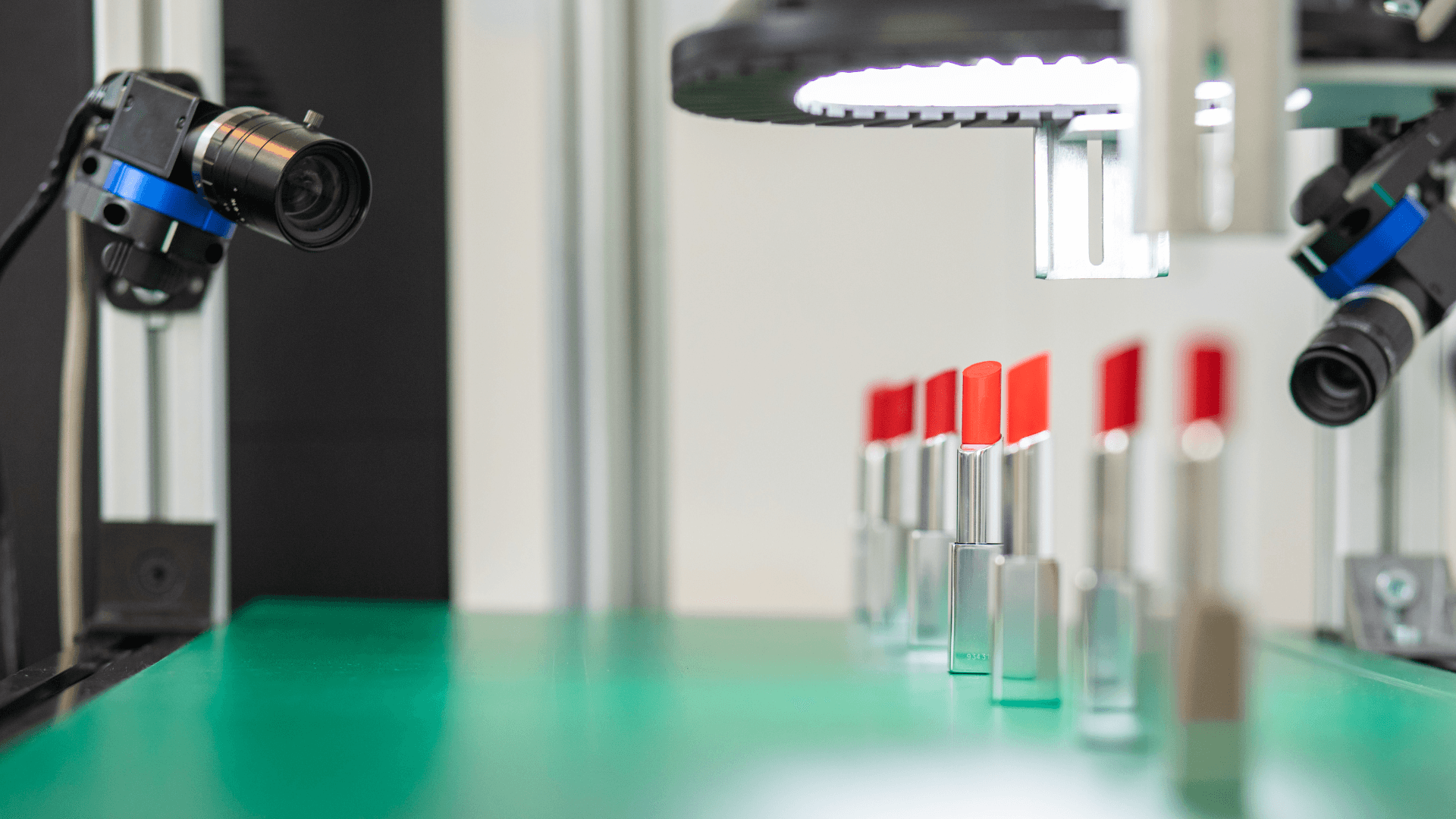
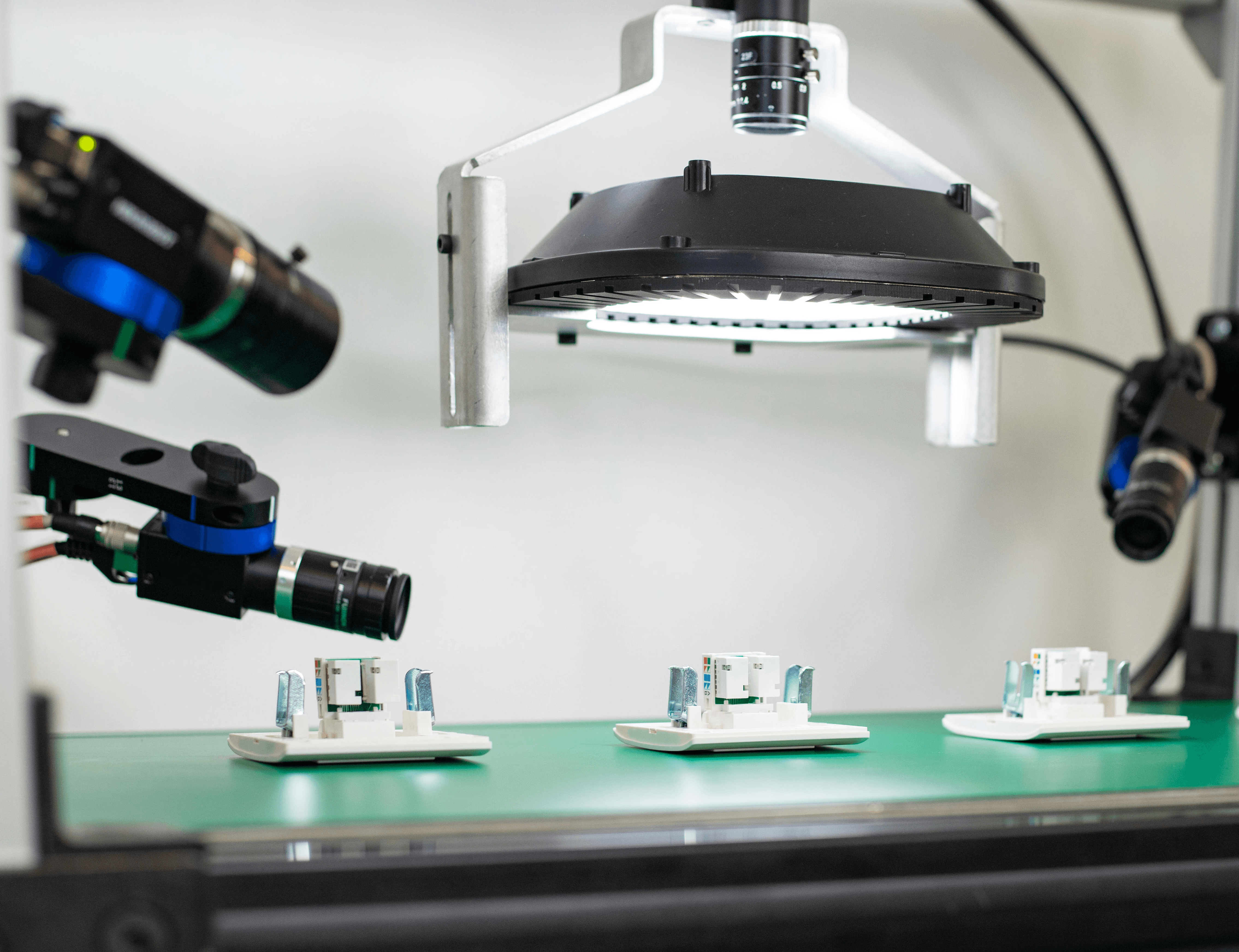
Our customers choose our automated AI-powered quality control solution to inspect cosmetic products or high-end packaging from several angles simultaneously in order to limit unseen areas during inspection.
The goal is not only to increase the detection rate. It is above all to stabilize quality decisions despite real production variations.
The often forgotten topic: consistency perceived by the end customer
In luxury, quality is not measured only piece by piece.
The customer unconsciously assesses the brand's overall consistency. A few products with visible defects can be enough to create a perception of inconsistency.
Some premium brands therefore now seek to minimize visual variations between products:
finishing consistency,
decoration regularity,
assembly stability,
consistent perceived quality.
Modern inspection tools also make it possible to exploit quality data over time: tracking recurring defects, trend analysis, identification of production drifts.
This approach helps manufacturers act more quickly before a quality problem becomes visible to the end customer.
Why some projects succeed better than others
The most robust projects in luxury are not necessarily those that promise the most automation.
They are often those that truly understand the field constraints of premium products.
At Scortex, we have found that manufacturers who achieve the best results generally work on the entire inspection chain:
dedicated vision setup (cameras and lighting),
multi-angle inspection in a single pass,
definition of quality criteria,
management of normal production variations.
They also involve field quality teams very early in order to avoid unrealistic detection criteria or ones impossible to stabilize at speed.
In premium environments, the success of a project often depends more on a fine understanding of appearance defects. This is precisely the expertise of the field quality team.
Quality control for luxury products is today evolving toward more consistent, more traceable, and more robust approaches to real industrial variations.
The goal is no longer only to identify a visible defect. It is to durably protect the experience perceived by the end customer and secure the brand image on products where aesthetics play a central role.
FAQ - Quality control for luxury products with AI
How to automate quality control for luxury products?
Automating quality control for premium products relies on much more than a simple camera. The most robust projects combine lighting adapted to shiny surfaces, multi-angle inspection, and AI capable of handling real production variations: fine decorations, color differences, reflections, complex geometries or frequent reference changes. The goal is to maintain a homogeneous quality decision at speed, while reducing complaints linked to appearance defects.
What defects can AI detect on luxury packaging?
According to the applications, AI can detect
· scratches,
· decoration defects,
· label positioning defects
· dust,
· impacts,
· chips
· printing defects,
· smears,
· pinholes,
· inclusions,
· excess material,
· or finishing irregularities on premium products.
How to automatically inspect perfume bottles or perfume caps?
Automated inspection, when properly executed, generally uses several cameras and dedicated lighting in order to inspect different sides of the product and secure the detection of visible defects on shiny or transparent surfaces.
Why do luxury brands use AI for quality control?
Premium brands seek to reduce customer complaints, standardize quality decisions and secure the visual appearance of products without increasing manual inspection workload.
Here are other articles that may interest you:
AI automated quality control: luxury industry
AI visual inspection for lipsticks
Behind the scenes of a luxury brand that revolutionized the quality control of its lipsticks
Protecting brand image through AI-assisted quality control of luxury goods
Published on
by
Scortex team
In the luxury industry, a visible defect is never just a simple defect.
A slight scratch on a perfume bottle cap, dust in premium packaging, a misaligned decoration, or an imperfection on a shiny part can be enough to immediately degrade a brand's perception. Where some industries tolerate slight aesthetic variations, premium products require a much higher level of precision. The end customer expects consistent visual perfection.
The problem is that this requirement is becoming more and more difficult to maintain in production.
Production speeds are increasing, product references are multiplying, runs are getting shorter, and products have ever more complex geometries. At the same time, quality teams must continue to detect defects that are sometimes extremely subtle, often on shiny or decorated surfaces.
In this context, many brands are now looking to strengthen quality control for luxury products with AI-assisted inspection systems capable of securing quality decisions without burdening field operations. The goal is not only to automate an inspection. It is to protect brand image over the long term and reduce the risk of customer complaints on high-perceived-value products.
In luxury, visual defect becomes immediately an image problem
In premium environments, quality control does not concern only the product's functional compliance.
Visual appearance is an integral part of the customer experience. A consumer who buys a premium perfume, a high-end wine or spirits bottle, or a luxury cosmetic product expects flawless finishing from the very first handling.
Some very slight imperfections can then become critical:
micro-scratches,
varnish defects,
dust,
burrs,
handling marks,
printing or decoration defects.
Sometimes, in the premium sector, manufacturers find that some complaints concern defects that are technically minor, but emotionally very visible.
This is particularly true on:
shiny surfaces,
metallized materials, with or without surface treatment, electroplating...
premium packaging,
finely decorated parts,
products highly exposed at the point of sale.
In some cosmetic or premium packaging production lines, operators inspect several hundred parts per hour with a very high aesthetic standard. This repetitiveness mechanically creates visual fatigue and variations in interpretation.
The challenge becomes even greater when:
products change frequently,
colors vary,
finishes evolve,
or several references coexist on the same line.
In these contexts, maintaining a perfectly consistent quality decision across an entire production run becomes particularly complex.
Manufacturers are then less looking to replace operators than to secure the first level of inspection in order to reduce detection variations and ease the most repetitive tasks.
Why luxury products are difficult to inspect automatically
Many players underestimate the real complexity of inspecting premium products.
The difficulties do not come solely from the defects themselves, but from the visual environment of the products.
Shiny or varnished surfaces strongly reflect light and attract dust. Metallized decorations change appearance depending on the viewing angle. Some imperfections become visible only under precise lighting.
In the cosmetics industry for example, quality teams often have to inspect products presenting:
mirror effects,
fine markings,
complex geometries,
color variations,
or visually very sensitive decorative elements.
Classic industrial vision systems programmed with fixed rules quickly reach their limits. A simple normal variation in reflection can be interpreted as a defect, generating false rejections and production instability.
What AI brings to quality control for luxury products
AI-based approaches make it possible to tackle appearance issues differently.
Instead of trying only to program fixed thresholds, the systems gradually learn the product's normal variations in order to identify truly significant anomalies.
This logic becomes particularly useful on premium products where defects are:
low-contrast,
variable,
sometimes difficult to formalize manually.
Our customers choose our automated AI-powered quality control solution to inspect cosmetic products or high-end packaging from several angles simultaneously in order to limit unseen areas during inspection.
The goal is not only to increase the detection rate. It is above all to stabilize quality decisions despite real production variations.
The often forgotten topic: consistency perceived by the end customer
In luxury, quality is not measured only piece by piece.
The customer unconsciously assesses the brand's overall consistency. A few products with visible defects can be enough to create a perception of inconsistency.
Some premium brands therefore now seek to minimize visual variations between products:
finishing consistency,
decoration regularity,
assembly stability,
consistent perceived quality.
Modern inspection tools also make it possible to exploit quality data over time: tracking recurring defects, trend analysis, identification of production drifts.
This approach helps manufacturers act more quickly before a quality problem becomes visible to the end customer.
Why some projects succeed better than others
The most robust projects in luxury are not necessarily those that promise the most automation.
They are often those that truly understand the field constraints of premium products.
At Scortex, we have found that manufacturers who achieve the best results generally work on the entire inspection chain:
dedicated vision setup (cameras and lighting),
multi-angle inspection in a single pass,
definition of quality criteria,
management of normal production variations.
They also involve field quality teams very early in order to avoid unrealistic detection criteria or ones impossible to stabilize at speed.
In premium environments, the success of a project often depends more on a fine understanding of appearance defects. This is precisely the expertise of the field quality team.
Quality control for luxury products is today evolving toward more consistent, more traceable, and more robust approaches to real industrial variations.
The goal is no longer only to identify a visible defect. It is to durably protect the experience perceived by the end customer and secure the brand image on products where aesthetics play a central role.
FAQ - Quality control for luxury products with AI
How to automate quality control for luxury products?
Automating quality control for premium products relies on much more than a simple camera. The most robust projects combine lighting adapted to shiny surfaces, multi-angle inspection, and AI capable of handling real production variations: fine decorations, color differences, reflections, complex geometries or frequent reference changes. The goal is to maintain a homogeneous quality decision at speed, while reducing complaints linked to appearance defects.
What defects can AI detect on luxury packaging?
According to the applications, AI can detect
· scratches,
· decoration defects,
· label positioning defects
· dust,
· impacts,
· chips
· printing defects,
· smears,
· pinholes,
· inclusions,
· excess material,
· or finishing irregularities on premium products.
How to automatically inspect perfume bottles or perfume caps?
Automated inspection, when properly executed, generally uses several cameras and dedicated lighting in order to inspect different sides of the product and secure the detection of visible defects on shiny or transparent surfaces.
Why do luxury brands use AI for quality control?
Premium brands seek to reduce customer complaints, standardize quality decisions and secure the visual appearance of products without increasing manual inspection workload.
Here are other articles that may interest you:
AI automated quality control: luxury industry
AI visual inspection for lipsticks
Behind the scenes of a luxury brand that revolutionized the quality control of its lipsticks
Let's discuss your quality today.

Scortex team is happy to answer your questions.
Let's discuss your quality today.
Scortex team is happy to answer your questions.

Join our newsletter
Some visuals on this site were generated using AI.
Join our newsletter
Some visuals on this site were generated using AI.