How to identify critical visual defects before customer complaints
Published on
by
Scortex Team
When a customer complaint occurs, one question systematically comes back: how could this defect have left the factory?
An investigation then begins to determine the origin of the problem, identify the batches potentially affected, and find the root cause.
If the defect is critical, the pressure is immediate. Risk of product return, delivery stoppage, emergency sorting, or degradation of the customer relationship: every minute gained in the analysis counts.
A defect in the raw material, a poorly adjusted conveyor, friction between parts, a worn tool, an assembly problem, an embossing defect, or a misplaced label can generate visual defects at any stage of production.
This is precisely what makes critical defects so difficult to control.
In many factories, the question is not just whether a defect exists, but at what point it appears and how many parts will be affected before it is detected.
When a drift goes unnoticed for several hours, the consequences can be significant: rework, scrap, manual sorting, quality wall, delivery delays, customer complaints, or batch rejection.
Yet, not all visual defects have the same level of severity. Some visual anomalies are essentially aesthetic. Others can call into question a product's functionality, compliance, or the manufacturer's brand image.
This is where the concept of critical defect comes in.
Understanding what distinguishes a minor, major, or critical defect allows control efforts to be focused where the economic risk is actually the highest.
In this article, we will see how to define a critical defect, why these anomalies cost manufacturers so much, and above all how to identify them before they become a customer complaint.
What is a critical visual defect?
A critical defect is a visual defect whose consequences go far beyond the aesthetic aspect.
It is a defect likely to lead to:
a customer complaint;
a product return;
a batch rejection;
an impact on safety or functionality;
damage to the brand image.
In certain industries, such as luxury, pharmaceuticals, or automotive and aviation, a simple appearance defect can be enough to push a part into the critical category.
In the premium cosmetics sector for example, a deep scratch or a visible inclusion on a decorated area can damage the consumer experience and lead to a product return. The quality standards used by major manufacturers thus classify certain defects affecting a decorative area or marking as critical defects.
In the medical industry, a scratch or a visual impact can reveal a much more serious problem. Certain surface marks on polished metal parts such as prostheses, for example, can promote corrosion or degrade essential mechanical properties.
A critical defect is therefore not necessarily the largest visible defect.
It is above all the one whose consequences are the most significant.
Minor, major, or critical defect: what is the difference?
One of the difficulties encountered in factories is that the boundary between the different levels of defect criticality is not always obvious.
In industrial defect libraries, classification is generally based on three levels.
Let's take a simple example.
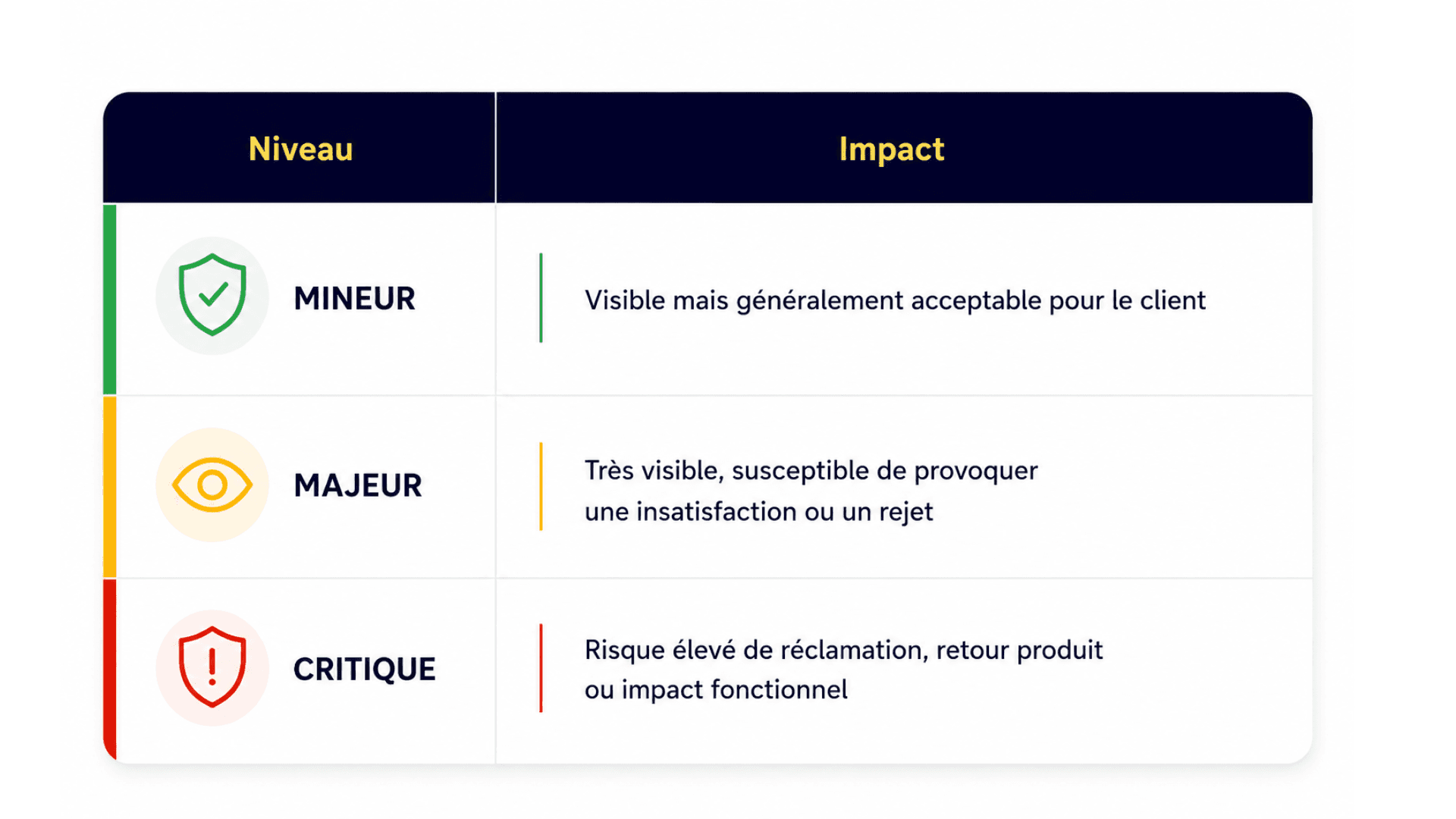
On a cosmetic part:
an isolated micro-scratch on a low-visibility area can be considered minor;
several visible scratches on a decorative area become major;
a scratch that degrades a logo, a marking, or the overall appearance of the product can become critical.
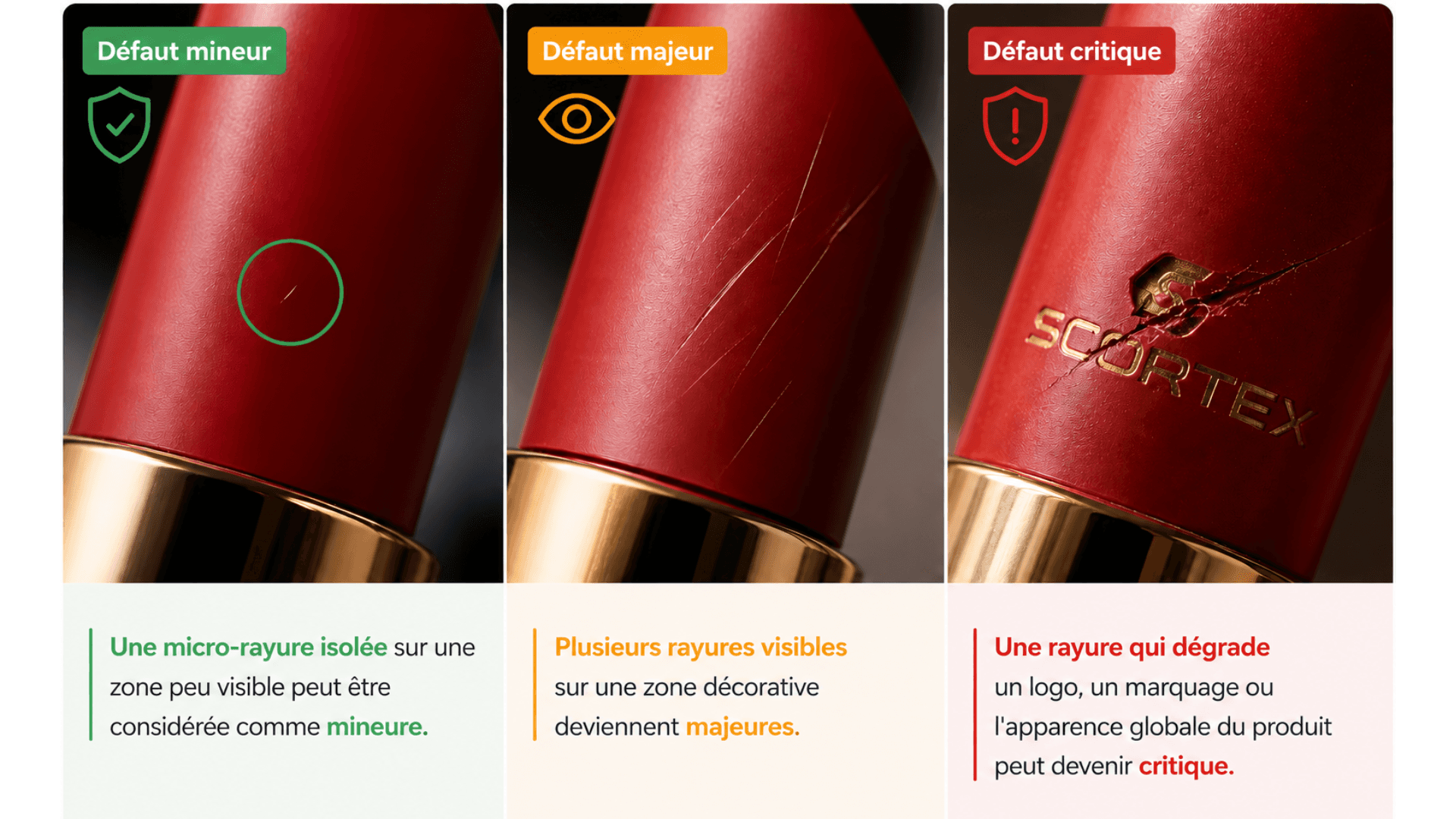
This logic is found in virtually all industrial sectors.
Criticality rarely depends on the type of defect alone. It also depends on its size, location, and business impact.
Why critical defects cost much more than others
In many factories, focus is on the scrap rate.
Yet, the cost of a critical defect is often much higher than that of a rejected part in production.
A shipped critical defect can generate:
sorting costs at the customer's site;
logistics returns;
additional quality analyses;
urgent corrective actions;
a loss of commercial trust.
In the premium, medical, automotive, or aerospace sectors, the indirect cost can become even more significant.
A quality manager from one of our customers, a leading cosmetics manufacturer, explained to us, for example, that certain appearance defects could directly affect the consumer's perception of product quality. Classification criteria are therefore built around the risk of product return and damage to the brand image.
In other words, criticality is often defined by the customer even before it is defined by the factory.
The types of visual defects most often classified as critical
Defect libraries used in different industries reveal interesting trends.
The most frequent critical defects are rarely the same depending on the sector.
Cosmetics and premium packaging
The most sensitive defects generally concern:
deep scratches
impacts
pits
inclusions
deformations
defects affecting logos or decorations
contamination or foreign bodies

In several quality standards, the presence of a foreign body is automatically considered critical and requires an immediate analysis of the root causes.
Machined metal parts
The most critical defects observed are often:
visible scratches
impacts
cracks
pits
polishing defects
tooling marks
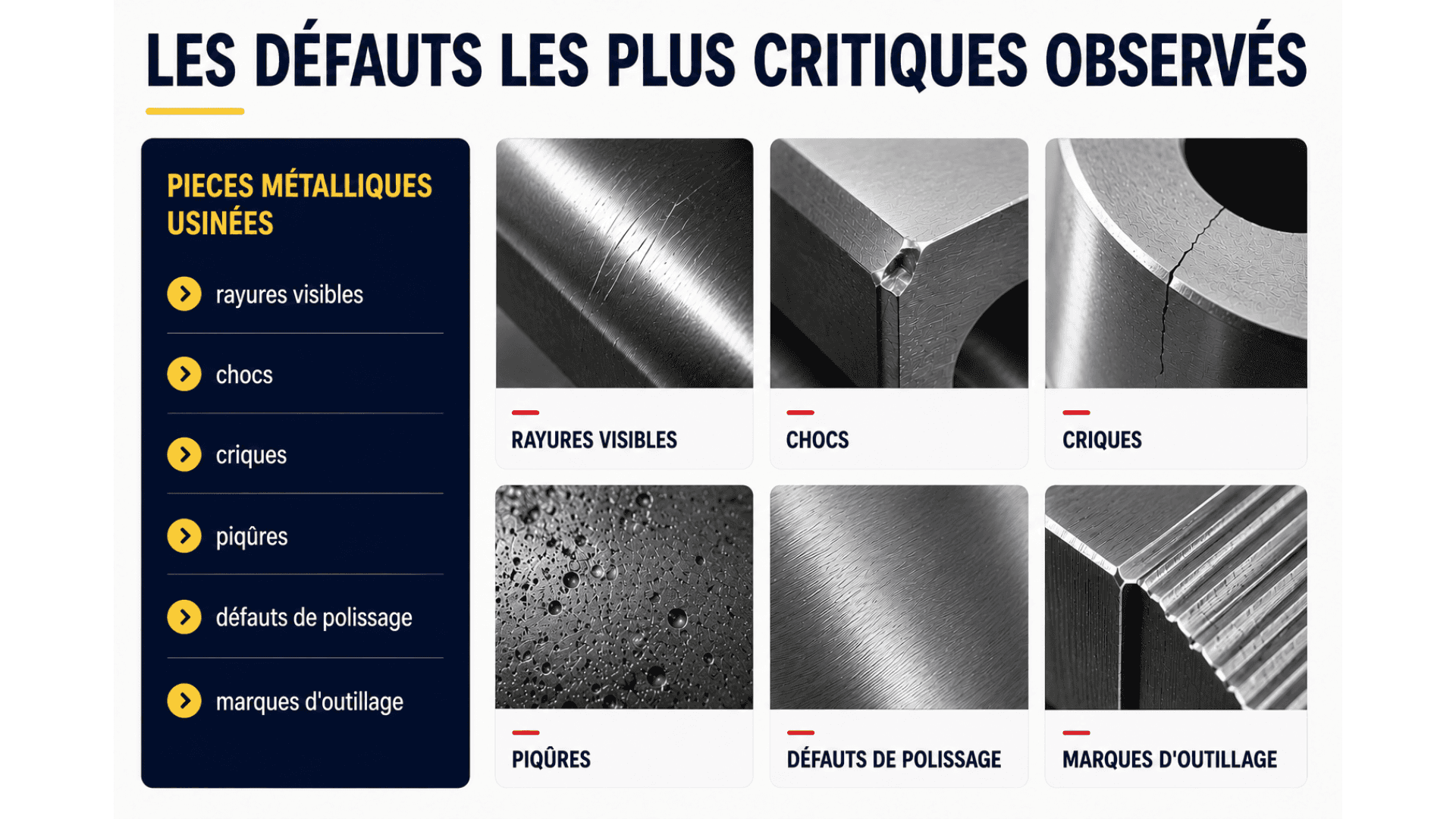
Some of these defects are classified as critical not because of their appearance but because they can reveal an underlying mechanical weakness.
Plastic injection parts
In these environments, manufacturers particularly monitor:
flashes
short shots
surface defects
burns
color defects
contaminations
defects on functional areas
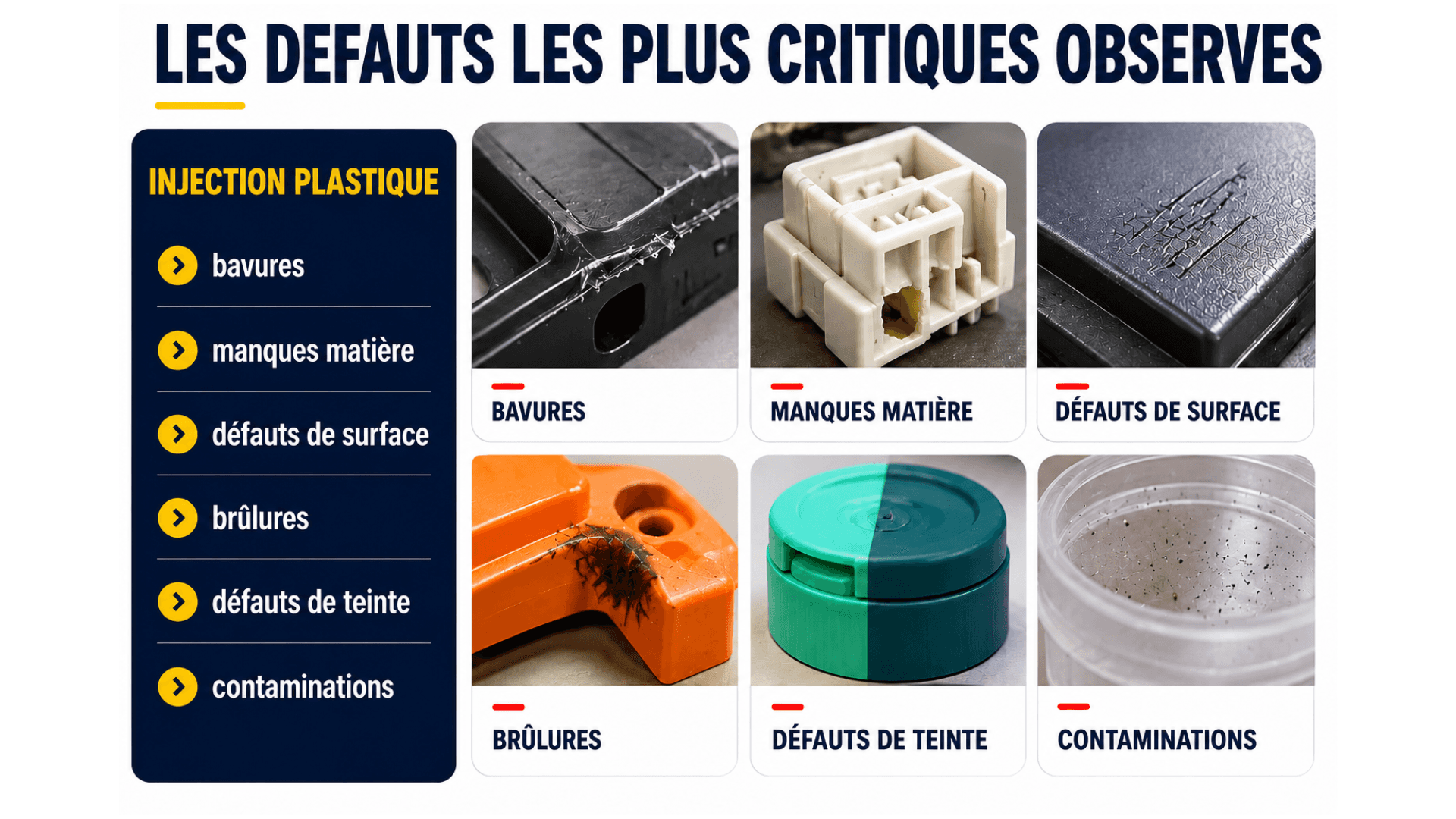
The level of criticality then depends heavily on the expectations of the end customer and the visibility of the defect.
Why critical defects are the hardest to control
Because the problem is not only detection.
The problem is that:
they sometimes appear intermittently
they can be generated at different stages of manufacturing
they evolve with equipment wear
they are not always present on all parts
they can affect only certain part numbers or machine settings
The paradox is that the most expensive defects are not always the easiest to see.
Several reasons explain this phenomenon.
First, some defects only appear under certain angles.
This is particularly true for shiny, metallic, or varnished surfaces.
Second, some anomalies are rare.
Operators can inspect several thousand compliant parts before encountering the critical defect in question.
Third, visual fatigue plays an important role.
In several industrial projects supported by Scortex, quality teams identified extremely infrequent defects with a very high customer impact. These anomalies were precisely the ones most likely to be missed during prolonged repetitive inspection. Scortex experts regularly find that critical defects represent a small proportion of observed defects but concentrate most of the economic risk.
Why defect libraries are essential
Defect libraries are often underestimated.
Yet, they constitute one of the most powerful tools for harmonizing quality decisions.
The best defect libraries do not just show a defect.
They explain:
why it is considered minor, major, or critical
its impact on the customer
acceptability limits
potential consequences
This is exactly what is found in the most advanced industrial standards. Some go so far as to link each defect to risks of corrosion, functional degradation, product return, or brand image damage.
How to identify critical defects before they leave the factory
The most effective approach today is to combine quality expertise, defect standards, and automated analysis.
The most advanced manufacturers no longer just look to detect known defects.
They also look to detect anomalies.
This approach allows the identification of unusual deviations that do not yet appear in existing defect libraries.
This is notably one of the benefits of AI-based automated inspection solutions like Spark by Scortex: they make it possible to flag unusual appearance variations to help quality teams focus their attention on the parts most at risk.
The goal is not to replace operators but to provide an additional safety net for the most critical defects.
When an anomaly is detected early enough, the factory can act before the problem turns into a customer complaint.
In practice, where should you focus your efforts?
We observe this with our customers, the manufacturers who sustainably reduce their customer complaints generally have three things in common:
They have a clear definition of critical defects
They systematically document real cases encountered in production.
They use inspection data to identify drifts before shipping.
The real challenge is not to detect more defects.
It is to detect the right defects at the right time.
A critical defect detected in production always costs less than a critical defect discovered by the customer.
Here are other articles that might interest you:
· Protecting brand image through AI-assisted luxury product quality control
· How the user experience of your vision system impacts your ROI
· Quality inspection: what for?
FAQ
What is a critical visual defect?
How to build an effective Defect library for quality control?
How do you classify a defect as minor, major, or critical?
Why do critical defects sometimes slip through quality control?
How to reduce customer complaints related to aspect defects?
How to identify critical visual defects before customer complaints
Published on
by
Scortex Team
When a customer complaint occurs, one question systematically comes back: how could this defect have left the factory?
An investigation then begins to determine the origin of the problem, identify the batches potentially affected, and find the root cause.
If the defect is critical, the pressure is immediate. Risk of product return, delivery stoppage, emergency sorting, or degradation of the customer relationship: every minute gained in the analysis counts.
A defect in the raw material, a poorly adjusted conveyor, friction between parts, a worn tool, an assembly problem, an embossing defect, or a misplaced label can generate visual defects at any stage of production.
This is precisely what makes critical defects so difficult to control.
In many factories, the question is not just whether a defect exists, but at what point it appears and how many parts will be affected before it is detected.
When a drift goes unnoticed for several hours, the consequences can be significant: rework, scrap, manual sorting, quality wall, delivery delays, customer complaints, or batch rejection.
Yet, not all visual defects have the same level of severity. Some visual anomalies are essentially aesthetic. Others can call into question a product's functionality, compliance, or the manufacturer's brand image.
This is where the concept of critical defect comes in.
Understanding what distinguishes a minor, major, or critical defect allows control efforts to be focused where the economic risk is actually the highest.
In this article, we will see how to define a critical defect, why these anomalies cost manufacturers so much, and above all how to identify them before they become a customer complaint.
What is a critical visual defect?
A critical defect is a visual defect whose consequences go far beyond the aesthetic aspect.
It is a defect likely to lead to:
a customer complaint;
a product return;
a batch rejection;
an impact on safety or functionality;
damage to the brand image.
In certain industries, such as luxury, pharmaceuticals, or automotive and aviation, a simple appearance defect can be enough to push a part into the critical category.
In the premium cosmetics sector for example, a deep scratch or a visible inclusion on a decorated area can damage the consumer experience and lead to a product return. The quality standards used by major manufacturers thus classify certain defects affecting a decorative area or marking as critical defects.
In the medical industry, a scratch or a visual impact can reveal a much more serious problem. Certain surface marks on polished metal parts such as prostheses, for example, can promote corrosion or degrade essential mechanical properties.
A critical defect is therefore not necessarily the largest visible defect.
It is above all the one whose consequences are the most significant.
Minor, major, or critical defect: what is the difference?
One of the difficulties encountered in factories is that the boundary between the different levels of defect criticality is not always obvious.
In industrial defect libraries, classification is generally based on three levels.
Let's take a simple example.
On a cosmetic part:
an isolated micro-scratch on a low-visibility area can be considered minor;
several visible scratches on a decorative area become major;
a scratch that degrades a logo, a marking, or the overall appearance of the product can become critical.
This logic is found in virtually all industrial sectors.
Criticality rarely depends on the type of defect alone. It also depends on its size, location, and business impact.
Why critical defects cost much more than others
In many factories, focus is on the scrap rate.
Yet, the cost of a critical defect is often much higher than that of a rejected part in production.
A shipped critical defect can generate:
sorting costs at the customer's site;
logistics returns;
additional quality analyses;
urgent corrective actions;
a loss of commercial trust.
In the premium, medical, automotive, or aerospace sectors, the indirect cost can become even more significant.
A quality manager from one of our customers, a leading cosmetics manufacturer, explained to us, for example, that certain appearance defects could directly affect the consumer's perception of product quality. Classification criteria are therefore built around the risk of product return and damage to the brand image.
In other words, criticality is often defined by the customer even before it is defined by the factory.
The types of visual defects most often classified as critical
Defect libraries used in different industries reveal interesting trends.
The most frequent critical defects are rarely the same depending on the sector.
Cosmetics and premium packaging
The most sensitive defects generally concern:
deep scratches
impacts
pits
inclusions
deformations
defects affecting logos or decorations
contamination or foreign bodies
In several quality standards, the presence of a foreign body is automatically considered critical and requires an immediate analysis of the root causes.
Machined metal parts
The most critical defects observed are often:
visible scratches
impacts
cracks
pits
polishing defects
tooling marks
Some of these defects are classified as critical not because of their appearance but because they can reveal an underlying mechanical weakness.
Plastic injection parts
In these environments, manufacturers particularly monitor:
flashes
short shots
surface defects
burns
color defects
contaminations
defects on functional areas
The level of criticality then depends heavily on the expectations of the end customer and the visibility of the defect.
Why critical defects are the hardest to control
Because the problem is not only detection.
The problem is that:
they sometimes appear intermittently
they can be generated at different stages of manufacturing
they evolve with equipment wear
they are not always present on all parts
they can affect only certain part numbers or machine settings
The paradox is that the most expensive defects are not always the easiest to see.
Several reasons explain this phenomenon.
First, some defects only appear under certain angles.
This is particularly true for shiny, metallic, or varnished surfaces.
Second, some anomalies are rare.
Operators can inspect several thousand compliant parts before encountering the critical defect in question.
Third, visual fatigue plays an important role.
In several industrial projects supported by Scortex, quality teams identified extremely infrequent defects with a very high customer impact. These anomalies were precisely the ones most likely to be missed during prolonged repetitive inspection. Scortex experts regularly find that critical defects represent a small proportion of observed defects but concentrate most of the economic risk.
Why defect libraries are essential
Defect libraries are often underestimated.
Yet, they constitute one of the most powerful tools for harmonizing quality decisions.
The best defect libraries do not just show a defect.
They explain:
why it is considered minor, major, or critical
its impact on the customer
acceptability limits
potential consequences
This is exactly what is found in the most advanced industrial standards. Some go so far as to link each defect to risks of corrosion, functional degradation, product return, or brand image damage.
How to identify critical defects before they leave the factory
The most effective approach today is to combine quality expertise, defect standards, and automated analysis.
The most advanced manufacturers no longer just look to detect known defects.
They also look to detect anomalies.
This approach allows the identification of unusual deviations that do not yet appear in existing defect libraries.
This is notably one of the benefits of AI-based automated inspection solutions like Spark by Scortex: they make it possible to flag unusual appearance variations to help quality teams focus their attention on the parts most at risk.
The goal is not to replace operators but to provide an additional safety net for the most critical defects.
When an anomaly is detected early enough, the factory can act before the problem turns into a customer complaint.
In practice, where should you focus your efforts?
We observe this with our customers, the manufacturers who sustainably reduce their customer complaints generally have three things in common:
They have a clear definition of critical defects
They systematically document real cases encountered in production.
They use inspection data to identify drifts before shipping.
The real challenge is not to detect more defects.
It is to detect the right defects at the right time.
A critical defect detected in production always costs less than a critical defect discovered by the customer.
Here are other articles that might interest you:
· Protecting brand image through AI-assisted luxury product quality control
· How the user experience of your vision system impacts your ROI
· Quality inspection: what for?
FAQ
What is a critical visual defect?
How to build an effective Defect library for quality control?
How do you classify a defect as minor, major, or critical?
Why do critical defects sometimes slip through quality control?
How to reduce customer complaints related to aspect defects?
Let's discuss your quality today.

Scortex team is happy to answer your questions.
Let's discuss your quality today.
Scortex team is happy to answer your questions.

Join our newsletter
Some visuals on this site were generated using AI.
Join our newsletter
Some visuals on this site were generated using AI.