Creating an industrial defect library: a practical guide
Published on
by
Scortex Team
The industrial defect library is often one of the most important documents in a quality system… and yet one of the least structured. In many factories, known defects are scattered across Excel files, presentations, photos stored on shared drives, or simply in the memory of experienced operators. When a customer complaint or a disagreement between teams arises, everyone then refers to their own interpretation of quality.
The problem becomes even more visible when the company wishes to automate part of its visual inspection. A machine applies rules consistently. It cannot rely on implicit criteria or on knowledge transmitted orally. What seemed to work with manual inspection then reveals its limits.
Creating an industrial defect library makes it possible to transform scattered knowledge into a shared repository, which can be used by quality, production, and methods teams. Well-constructed, it reduces subjectivity, facilitates training, accelerates root cause analysis, and helps reduce customer complaints. Here is a concrete method to set it up.
Why create an industrial defect library?
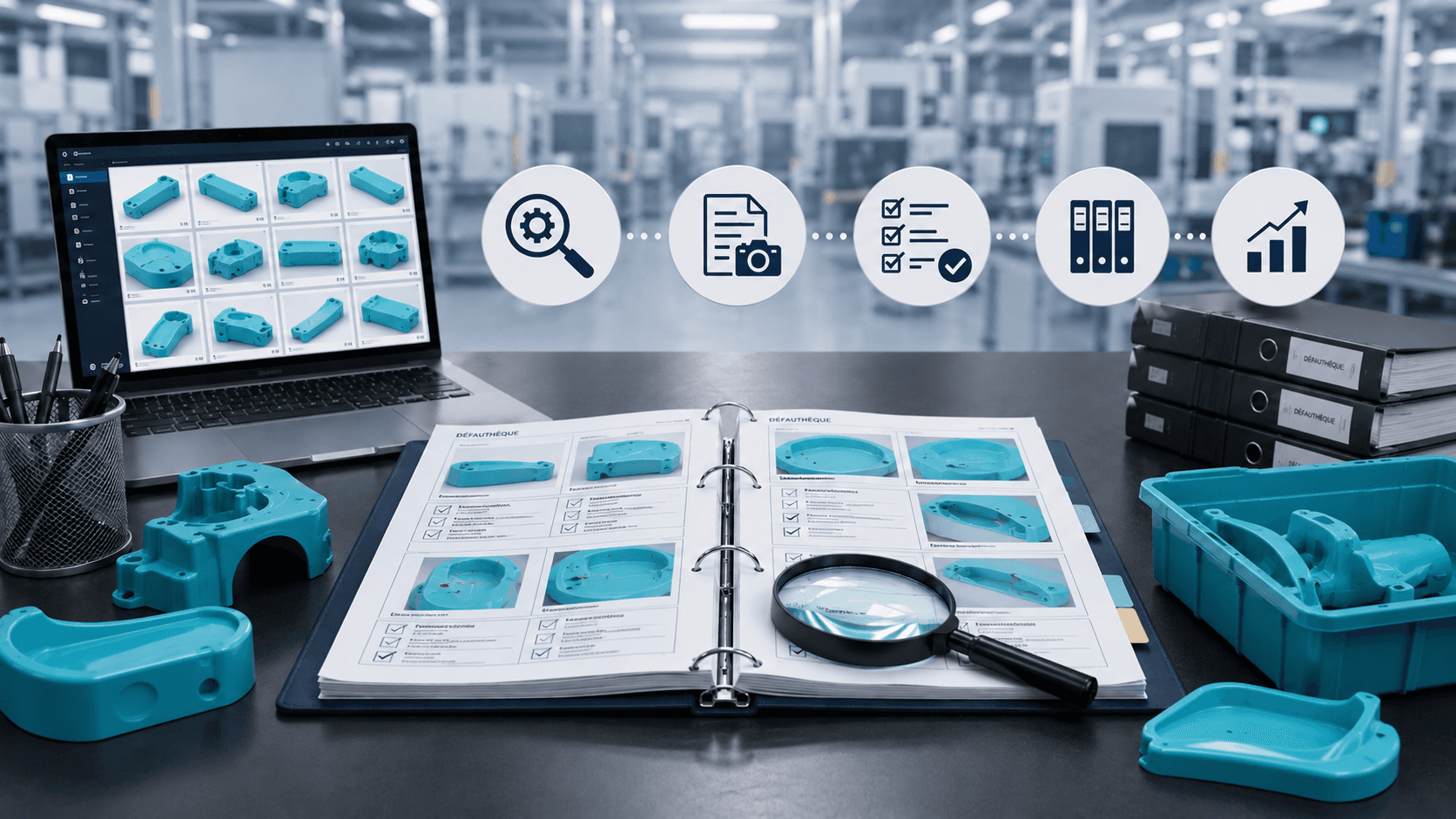
An industrial defect library is a documented library gathering the defects observed on manufactured products.
Its objective is not simply to store photos of non-conformities. It serves to align the entire company around a common definition of quality.
In reality, the absence of a defect library often leads to the same consequences:
Different decisions depending on the operators
Disagreements between quality and production
Difficulties in training new arrivals
Customer complaints whose causes are difficult to analyze
This situation is common. Many manufacturers have partial or outdated quality specifications, but rarely a complete visual library representing the reality of production.
Step 1: identify the defects actually observed
The first mistake is to create a theoretical defect library.
An effective defect library must be built from the defects encountered in production.
Start by analyzing:
Customer complaints from recent years
The most frequent internal scraps
Defects detected during quality controls
Recurring process-related incidents
This approach makes it possible to focus efforts on the problems that actually generate non-quality.
In plastic injection, burrs, lack of material, or burns often appear among the first candidates. In machined metal, scratches, impacts, chips, or porosities frequently recur. In cosmetics and premium packaging, appearance defects generally dominate: gloss defects, decorative defects, or micro-scratches.
Step 2: classify defects by criticality level
One of the recurring findings observed by Scortex teams is that many companies document defects without prioritizing them.
However, not all defects have the same impact on the end customer.
A simple classification generally yields better results:
Critical defect: immediate rejection
Major defect: significant impact on perceived quality or usage
Minor defect: visible defect but acceptable under conditions
Acceptable anomaly: observed deviation but tolerated
This last category is particularly important.
In many factories, only defects are documented. Acceptable cases rarely are. Yet, the gray areas lie precisely between these two categories. A visible anomaly is not necessarily a defect.
This nuance often makes it possible to reduce false rejects and improve the consistency of quality decisions.
Step 3: document with representative images
A phrase alone is not enough.
For example, the mention "acceptable slight scratch" can be interpreted differently depending on people, teams, or production sites.
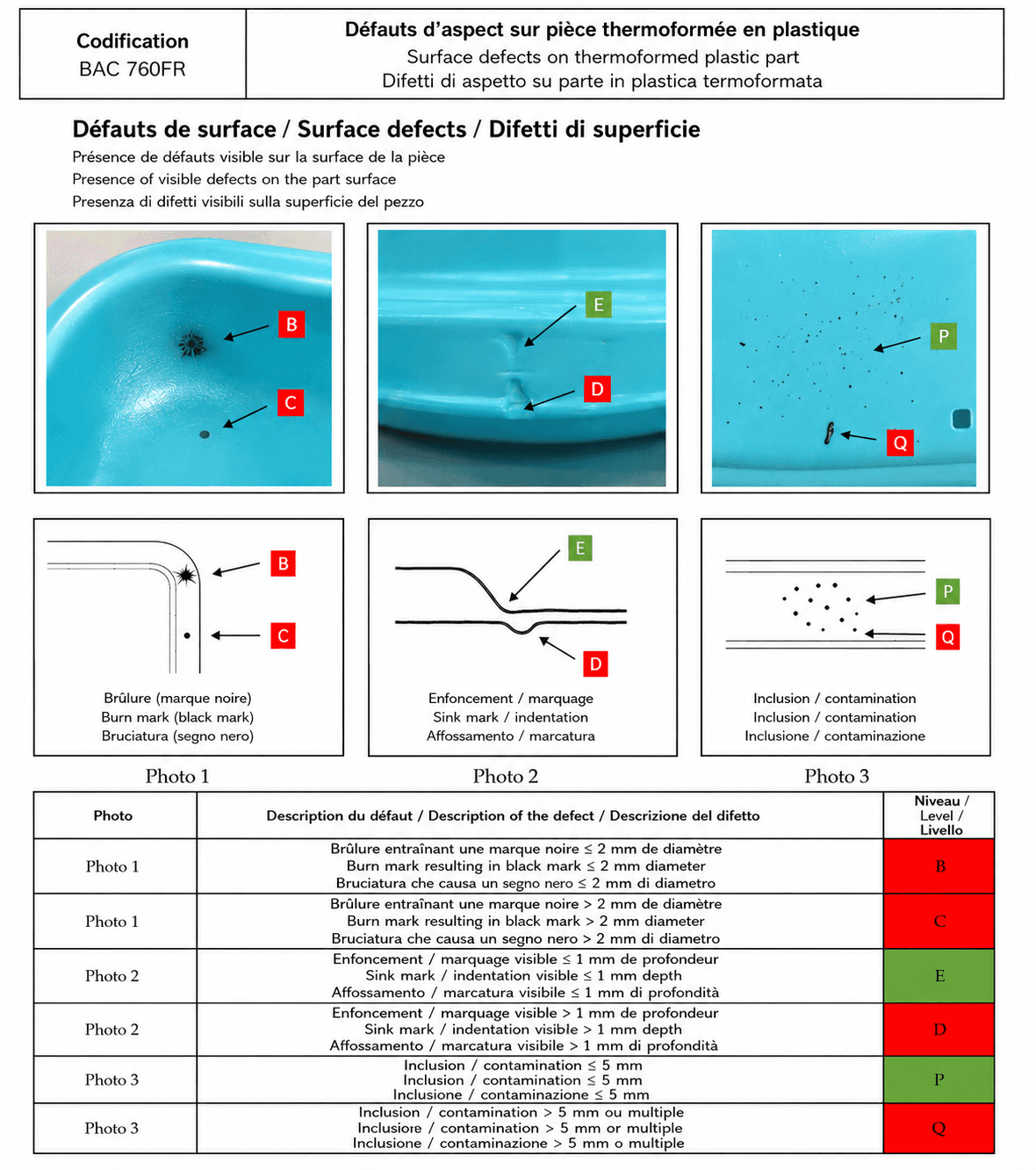
Each entry in the defect library should include:
A photo of the defect
· A description of the defect and its characteristics
· Its level of criticality for the end customer
· The criteria for distinguishing a compliant part from a non-compliant part
When possible, several examples should be presented.
This diversity is essential because industrial defects are rarely identical from one part to another. The same scratch can appear under different angles, on different materials, or in different areas of the product.
Step 4: integrate the most experienced operators
A defect library should not be built solely by the quality department.
Experienced operators often possess extremely valuable practical knowledge.
In some industries, several years are required to train a quality controller capable of quickly identifying critical defects. Part of this knowledge remains tacit and difficult to formalize.
The objective of the defect library is precisely to capture this expertise.
Involving operators from the start not only improves the quality of the content, but also promotes the future adoption of the defined standards.
Step 5: keep the defect library alive over time
One of the most frequent errors is to consider the defect library as a one-off project.
Quality is constantly changing.
Materials change. Suppliers change. Machine settings change. New defects appear.
An industrial defect library must therefore evolve with production.
The most mature companies regularly update their library based on:
New defects observed
Customer complaints
Audit feedback
Inspection data collected during production
This process progressively transforms the defect library into a true quality memory of the factory.
The growing role of data in the modern defect library
Historically, defect libraries were built from photos taken manually.
Today, automated inspection systems, like Spark by Scortex, make it possible to generate a considerable amount of visual data.
Each inspection can produce:
An image of the part
A quality decision
A timestamp
A precise location of the anomaly
This capability opens up new possibilities.
Quality managers can enrich their defect library from real cases observed daily. They then have examples representing real production conditions and not images selected periodically.
Some AI-based inspection solutions, like Spark, also allow visualization of detected anomalies using heat maps. This information facilities the identification of the most sensitive areas and progressively feeds the defect library with documented and contextualized cases.
Why a defect library facilitates quality control automation
Many manufacturers discover the limits of their quality standards when launching an automation project.
Automation does not invent rules. It applies those that already exist.
When criteria are vague, inconsistencies become visible.
The creation of an industrial defect library is therefore often an essential preliminary step. It clarifies expectations, aligns teams, and defines consistent levels of severity before any automation.
The most successful projects do not consist of replacing human expertise. They aim to formalize, share, and make it reproducible.
A well-built industrial defect library quickly becomes much more than a catalog of defects. It constitutes a common language between quality, production, and methods. It reduces subjectivity, facilitates the transfer of knowledge, and provides a solid foundation for continuous improvement. Companies that consider it a living document generally have better control over their quality standards and a greater capacity to sustainably reduce customer complaints.
Here are other articles that might interest you:
FAQ
What is an industrial defect database?
How to create an industrial Defect Library?
Which defects should be included in a defect library?
Why is a defect library useful for training new operators?
Creating an industrial defect library: a practical guide
Published on
by
Scortex Team
The industrial defect library is often one of the most important documents in a quality system… and yet one of the least structured. In many factories, known defects are scattered across Excel files, presentations, photos stored on shared drives, or simply in the memory of experienced operators. When a customer complaint or a disagreement between teams arises, everyone then refers to their own interpretation of quality.
The problem becomes even more visible when the company wishes to automate part of its visual inspection. A machine applies rules consistently. It cannot rely on implicit criteria or on knowledge transmitted orally. What seemed to work with manual inspection then reveals its limits.
Creating an industrial defect library makes it possible to transform scattered knowledge into a shared repository, which can be used by quality, production, and methods teams. Well-constructed, it reduces subjectivity, facilitates training, accelerates root cause analysis, and helps reduce customer complaints. Here is a concrete method to set it up.
Why create an industrial defect library?
An industrial defect library is a documented library gathering the defects observed on manufactured products.
Its objective is not simply to store photos of non-conformities. It serves to align the entire company around a common definition of quality.
In reality, the absence of a defect library often leads to the same consequences:
Different decisions depending on the operators
Disagreements between quality and production
Difficulties in training new arrivals
Customer complaints whose causes are difficult to analyze
This situation is common. Many manufacturers have partial or outdated quality specifications, but rarely a complete visual library representing the reality of production.
Step 1: identify the defects actually observed
The first mistake is to create a theoretical defect library.
An effective defect library must be built from the defects encountered in production.
Start by analyzing:
Customer complaints from recent years
The most frequent internal scraps
Defects detected during quality controls
Recurring process-related incidents
This approach makes it possible to focus efforts on the problems that actually generate non-quality.
In plastic injection, burrs, lack of material, or burns often appear among the first candidates. In machined metal, scratches, impacts, chips, or porosities frequently recur. In cosmetics and premium packaging, appearance defects generally dominate: gloss defects, decorative defects, or micro-scratches.
Step 2: classify defects by criticality level
One of the recurring findings observed by Scortex teams is that many companies document defects without prioritizing them.
However, not all defects have the same impact on the end customer.
A simple classification generally yields better results:
Critical defect: immediate rejection
Major defect: significant impact on perceived quality or usage
Minor defect: visible defect but acceptable under conditions
Acceptable anomaly: observed deviation but tolerated
This last category is particularly important.
In many factories, only defects are documented. Acceptable cases rarely are. Yet, the gray areas lie precisely between these two categories. A visible anomaly is not necessarily a defect.
This nuance often makes it possible to reduce false rejects and improve the consistency of quality decisions.
Step 3: document with representative images
A phrase alone is not enough.
For example, the mention "acceptable slight scratch" can be interpreted differently depending on people, teams, or production sites.
Each entry in the defect library should include:
A photo of the defect
· A description of the defect and its characteristics
· Its level of criticality for the end customer
· The criteria for distinguishing a compliant part from a non-compliant part
When possible, several examples should be presented.
This diversity is essential because industrial defects are rarely identical from one part to another. The same scratch can appear under different angles, on different materials, or in different areas of the product.
Step 4: integrate the most experienced operators
A defect library should not be built solely by the quality department.
Experienced operators often possess extremely valuable practical knowledge.
In some industries, several years are required to train a quality controller capable of quickly identifying critical defects. Part of this knowledge remains tacit and difficult to formalize.
The objective of the defect library is precisely to capture this expertise.
Involving operators from the start not only improves the quality of the content, but also promotes the future adoption of the defined standards.
Step 5: keep the defect library alive over time
One of the most frequent errors is to consider the defect library as a one-off project.
Quality is constantly changing.
Materials change. Suppliers change. Machine settings change. New defects appear.
An industrial defect library must therefore evolve with production.
The most mature companies regularly update their library based on:
New defects observed
Customer complaints
Audit feedback
Inspection data collected during production
This process progressively transforms the defect library into a true quality memory of the factory.
The growing role of data in the modern defect library
Historically, defect libraries were built from photos taken manually.
Today, automated inspection systems, like Spark by Scortex, make it possible to generate a considerable amount of visual data.
Each inspection can produce:
An image of the part
A quality decision
A timestamp
A precise location of the anomaly
This capability opens up new possibilities.
Quality managers can enrich their defect library from real cases observed daily. They then have examples representing real production conditions and not images selected periodically.
Some AI-based inspection solutions, like Spark, also allow visualization of detected anomalies using heat maps. This information facilities the identification of the most sensitive areas and progressively feeds the defect library with documented and contextualized cases.
Why a defect library facilitates quality control automation
Many manufacturers discover the limits of their quality standards when launching an automation project.
Automation does not invent rules. It applies those that already exist.
When criteria are vague, inconsistencies become visible.
The creation of an industrial defect library is therefore often an essential preliminary step. It clarifies expectations, aligns teams, and defines consistent levels of severity before any automation.
The most successful projects do not consist of replacing human expertise. They aim to formalize, share, and make it reproducible.
A well-built industrial defect library quickly becomes much more than a catalog of defects. It constitutes a common language between quality, production, and methods. It reduces subjectivity, facilitates the transfer of knowledge, and provides a solid foundation for continuous improvement. Companies that consider it a living document generally have better control over their quality standards and a greater capacity to sustainably reduce customer complaints.
Here are other articles that might interest you:
FAQ
What is an industrial defect database?
How to create an industrial Defect Library?
Which defects should be included in a defect library?
Why is a defect library useful for training new operators?
Let's discuss your quality today.

Scortex team is happy to answer your questions.
Let's discuss your quality today.
Scortex team is happy to answer your questions.

Join our newsletter
Some visuals on this site were generated using AI.
Join our newsletter
Some visuals on this site were generated using AI.