Cosmetic and Packaging Quality Control: Securing the Inspection of Demanding Surfaces with AI
Published on
by
Scortex team
In the world of luxury and premium products, a micro-defect can be enough to damage a brand's image. Barely visible scratches, embedded dust, misleading reflections on varnished or metallic surfaces... Cosmetic and packaging quality control has become an exercise in high precision.
However, on the production lines, the reality is complex: speed, material variability, frequent changes in formats, fine decorations, shiny or translucent parts. Human visual inspection remains essential, but it quickly reaches its limits when faced with the repetitiveness and subtlety of certain defects.
Since 2016, Scortex has been supporting manufacturers in this transformation. In ten years, the company has specialized in the automation of appearance inspection using artificial intelligence, with an approach centered on industrial robustness and measurable performance.
Why is cosmetic and packaging quality control so demanding?
Parts from these sectors often combine several difficulties:
Reflective surfaces generating stray reflections
Very fine screen-printed or metallized decorations
Sensitivity to dust and handling marks
Strict aesthetic tolerances
Non-perfectly repeatable position of products online
Traditional systems, based on fixed rules or predefined thresholds, struggle to distinguish an acceptable variation from a critical defect. Each new reference implies adjustments, which are sometimes long and unstable.
The challenge is not only to detect more, but to detect correctly. Too many rejects penalize productivity. Too few rejects expose to costly customer complaints.
An approach through learning the compliant appearance
To meet these constraints, Scortex has developed Spark, a visual inspection solution based on anomaly detection. Rather than trying to list all possible defects, the system learns what a compliant part is, and then automatically identifies any significant deviation.
This approach offers several advantages:
Less reliance on exhaustive defect libraries (defect library)
Ability to detect defects that are difficult to formalize
Adaptation to natural variations in light or material
Stability on complex geometries
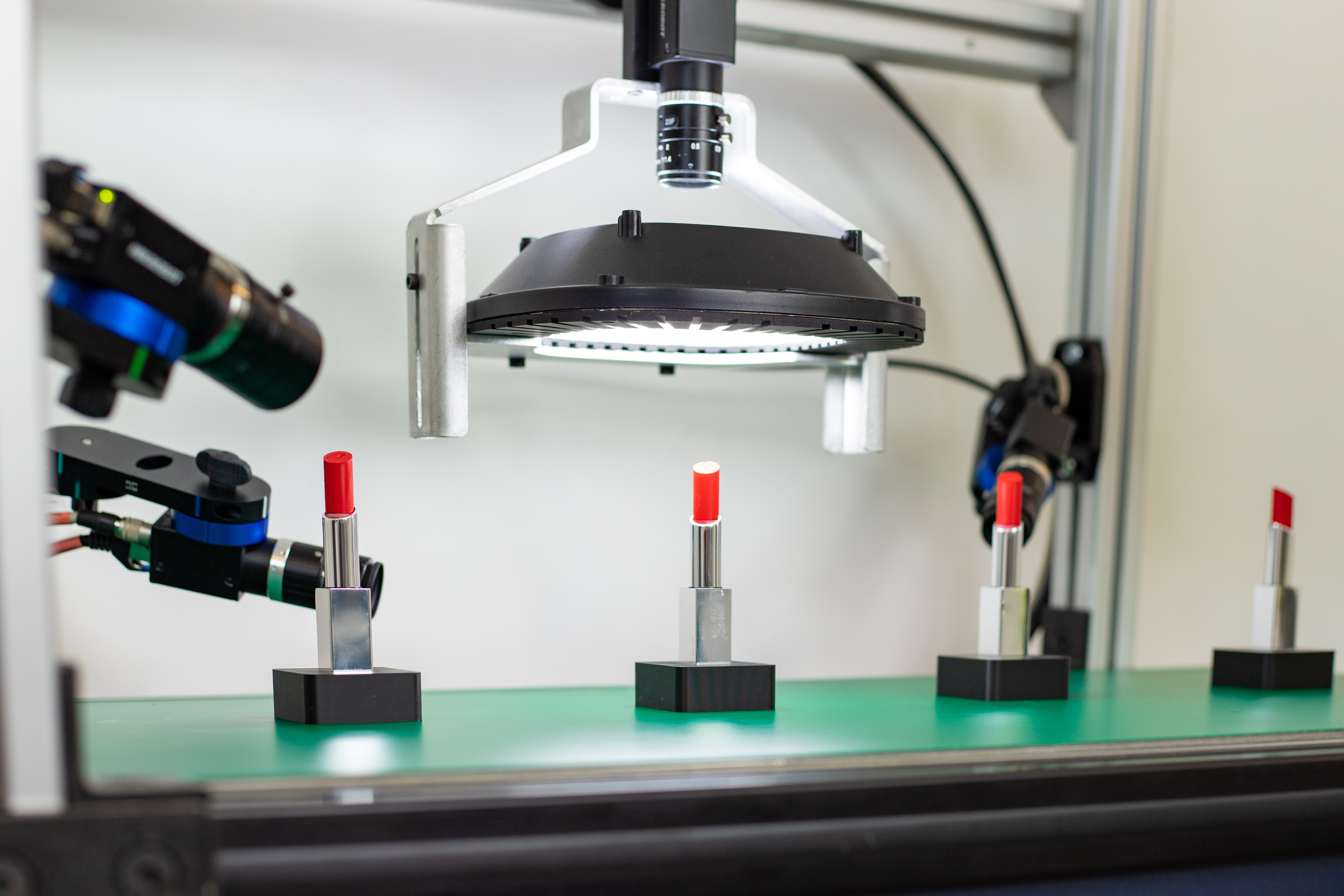
The multi-angle optical architecture, featuring lighting adapted to shiny or textured surfaces, completes the algorithm to guarantee reliable detection in a real environment.
Beyond detection: leveraging quality data
Automating inspection is not enough. We still need to understand the causes of non-conformities.
The associated software platform makes it possible to analyze the data collected online: typology of defects, frequency, deviations by batch or by machine. Quality teams thus have concrete indicators to drive continuous improvement.
This global vision transforms cosmetics and packaging quality control into a real driver of industrial performance, beyond the simple sorting of parts.
Ten years of field expertise at the service of manufacturers
Since its creation in 2016, Scortex has operated on production lines faced with high aesthetic requirements: plastic, metal or alloy packaging, decorated components, surface treatments, premium parts with high perceived value.
This accumulated experience has enabled us to refine:
The methods for scoping use cases
The choices of optical implementation
The learning strategies for AI models
Performance tracking over time
The goal remains constant: to strengthen the reliability of control while relieving operators of a repetitive and demanding task.
In a context where perceived quality is a key differentiating factor, securing each part at the end of the line becomes strategic. AI does not replace human expertise: it augments it. And in the cosmetics and packaging sector, this alliance is now making the difference.
Here are other articles that might interest you:
Visual inspection by AI for shiny parts
Automated quality control by AI: luxury industry
How to secure the quality control of metal parts with AI
Cosmetic and Packaging Quality Control: Securing the Inspection of Demanding Surfaces with AI
Published on
by
Scortex team
In the world of luxury and premium products, a micro-defect can be enough to damage a brand's image. Barely visible scratches, embedded dust, misleading reflections on varnished or metallic surfaces... Cosmetic and packaging quality control has become an exercise in high precision.
However, on the production lines, the reality is complex: speed, material variability, frequent changes in formats, fine decorations, shiny or translucent parts. Human visual inspection remains essential, but it quickly reaches its limits when faced with the repetitiveness and subtlety of certain defects.
Since 2016, Scortex has been supporting manufacturers in this transformation. In ten years, the company has specialized in the automation of appearance inspection using artificial intelligence, with an approach centered on industrial robustness and measurable performance.
Why is cosmetic and packaging quality control so demanding?
Parts from these sectors often combine several difficulties:
Reflective surfaces generating stray reflections
Very fine screen-printed or metallized decorations
Sensitivity to dust and handling marks
Strict aesthetic tolerances
Non-perfectly repeatable position of products online
Traditional systems, based on fixed rules or predefined thresholds, struggle to distinguish an acceptable variation from a critical defect. Each new reference implies adjustments, which are sometimes long and unstable.
The challenge is not only to detect more, but to detect correctly. Too many rejects penalize productivity. Too few rejects expose to costly customer complaints.
An approach through learning the compliant appearance
To meet these constraints, Scortex has developed Spark, a visual inspection solution based on anomaly detection. Rather than trying to list all possible defects, the system learns what a compliant part is, and then automatically identifies any significant deviation.
This approach offers several advantages:
Less reliance on exhaustive defect libraries (defect library)
Ability to detect defects that are difficult to formalize
Adaptation to natural variations in light or material
Stability on complex geometries
The multi-angle optical architecture, featuring lighting adapted to shiny or textured surfaces, completes the algorithm to guarantee reliable detection in a real environment.
Beyond detection: leveraging quality data
Automating inspection is not enough. We still need to understand the causes of non-conformities.
The associated software platform makes it possible to analyze the data collected online: typology of defects, frequency, deviations by batch or by machine. Quality teams thus have concrete indicators to drive continuous improvement.
This global vision transforms cosmetics and packaging quality control into a real driver of industrial performance, beyond the simple sorting of parts.
Ten years of field expertise at the service of manufacturers
Since its creation in 2016, Scortex has operated on production lines faced with high aesthetic requirements: plastic, metal or alloy packaging, decorated components, surface treatments, premium parts with high perceived value.
This accumulated experience has enabled us to refine:
The methods for scoping use cases
The choices of optical implementation
The learning strategies for AI models
Performance tracking over time
The goal remains constant: to strengthen the reliability of control while relieving operators of a repetitive and demanding task.
In a context where perceived quality is a key differentiating factor, securing each part at the end of the line becomes strategic. AI does not replace human expertise: it augments it. And in the cosmetics and packaging sector, this alliance is now making the difference.
Here are other articles that might interest you:
Visual inspection by AI for shiny parts
Automated quality control by AI: luxury industry
How to secure the quality control of metal parts with AI

Let's discuss your quality today.

Scortex team is happy to answer your questions.
Let's discuss your quality today.
Scortex team is happy to answer your questions.

Join our newsletter
Some visuals on this site were generated using AI.
Join our newsletter
Some visuals on this site were generated using AI.