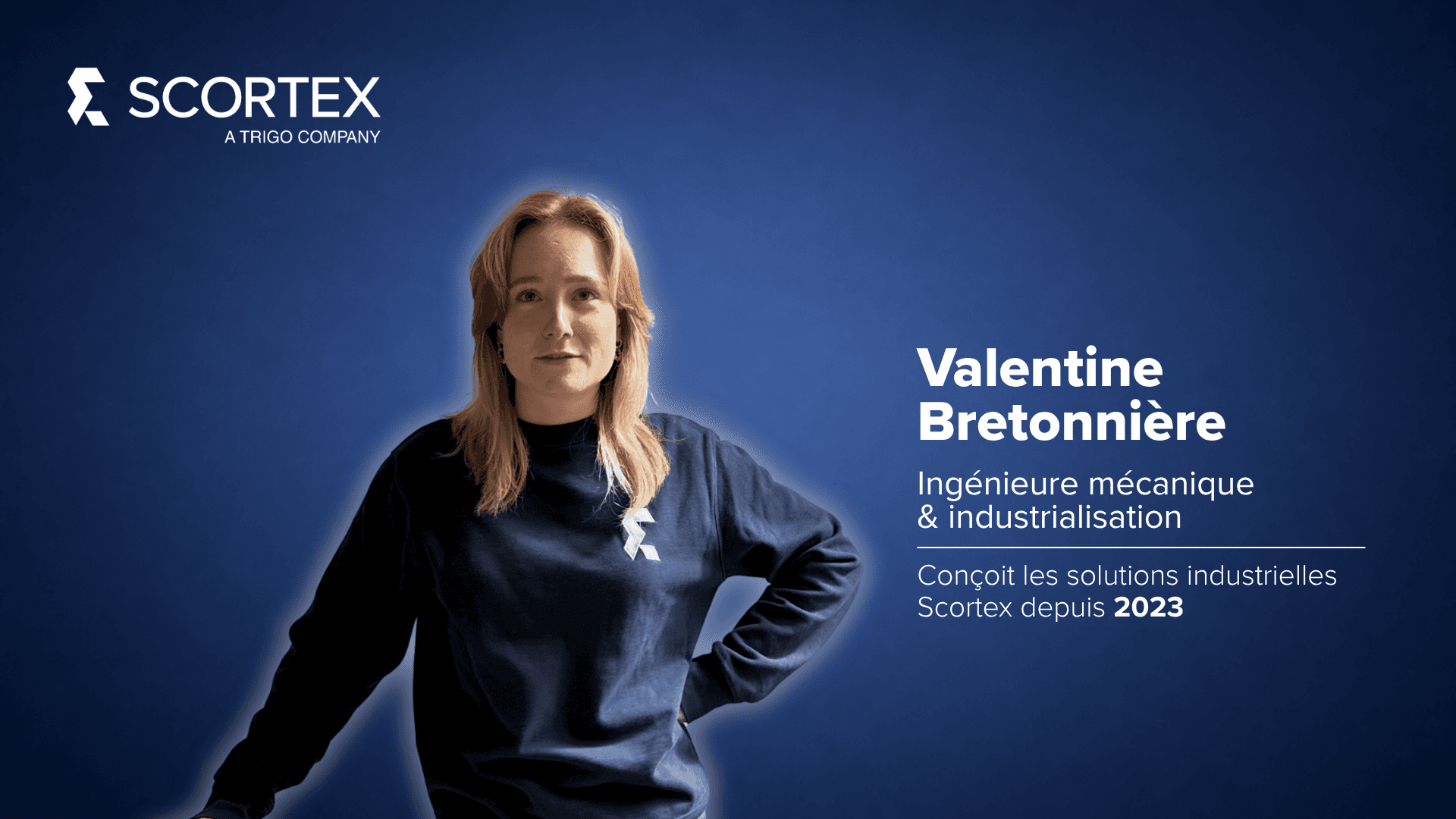
Valentine Bretonnière, the engineer who gives shape to Spark
Joining Scortex in 2023, Valentine Bretonnière participates in the design and industrialization of Spark. Between modeling, prototyping, and factory deployments, she contributes to transforming complex technical challenges into robust solutions capable of meeting the demands of the field.
When did you join Scortex and what is your role today?
I joined Scortex in early 2023 for an internship, and I quickly wanted to continue the adventure. This naturally led me to join the team as a permanent employee as a mechanical and industrialization engineer.
My daily routine revolves around two missions that complement each other well. The first is mechanical design: in close collaboration with the tech teams, I design the mechanical elements integrated into our vision setups deployed in factories. I manage the project from end to end, from design to supplier purchasing. It is a complete role that really suits me.
My second mission is the industrialization of our Spark product: the challenge is to build this product in a repeatable and controlled manner internally. This involves managing purchasing, creating technical documentation (assembly, wiring), and solving the challenges that accompany each hardware evolution.
What does a typical day look like for you, and what are your key missions?
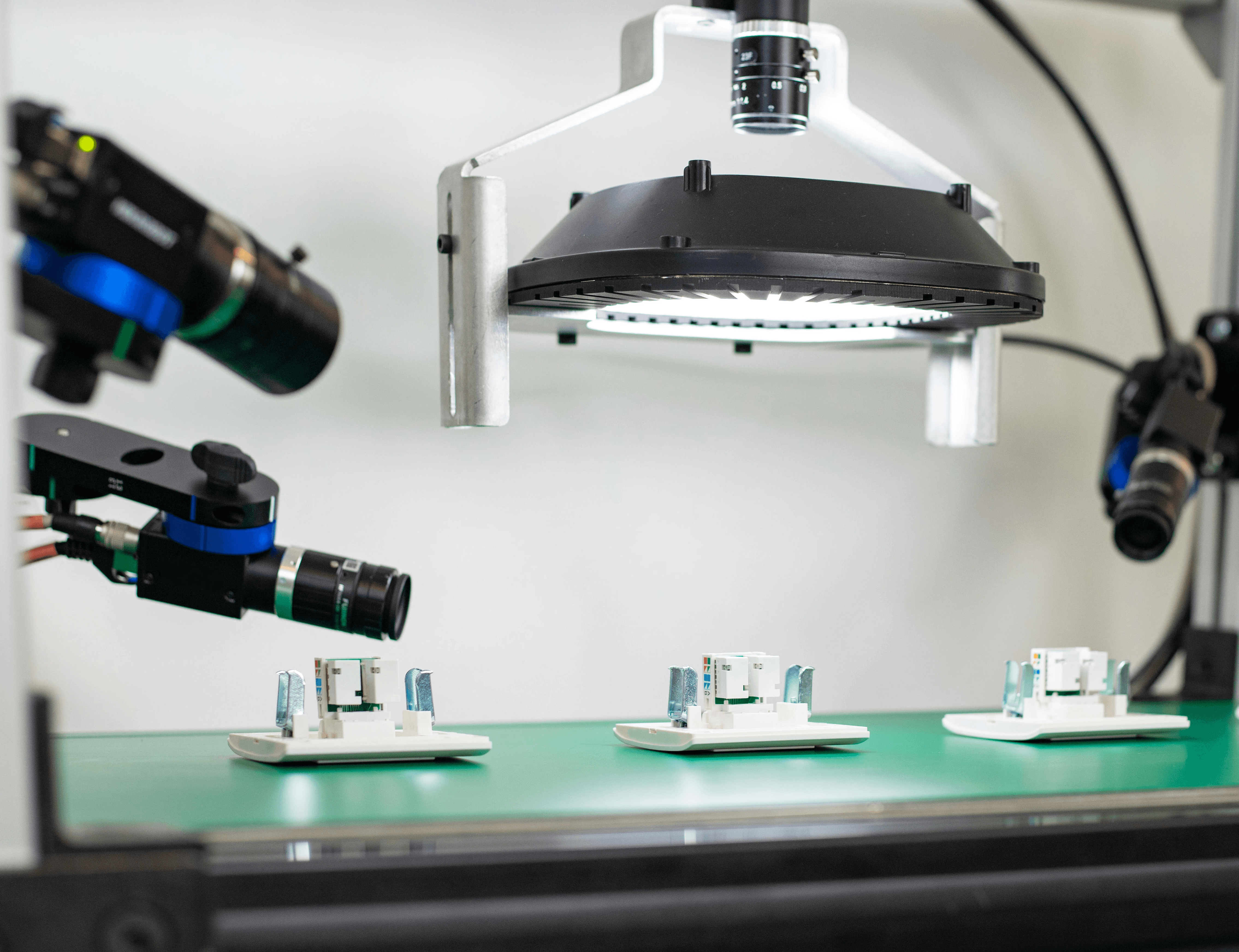
What I really like about this role is the back-and-forth between computer-aided design and assembling prototypes in the workshop. We test, we iterate, we make it concrete. Collaboration with the product and software teams allows us to carry out ambitious projects, such as the transition to 4 cameras on Spark in early 2024. I also regularly work with hardware suppliers to evaluate the latest innovations such as cameras, lighting, and identify what could enrich our product.
After these 3 years at Scortex, what do you think has allowed the company to become a pioneer of AI applied to quality control?
What sets Scortex apart is its ability to address really complex use cases, shiny parts in the medical sector, glass bottles... What strikes me is how the team manages to transform this complexity into a simple and accessible product: the Quality Center, our solution that processes quality data, is, in my opinion, intuitive for all profiles. The technical depth of Scortex is a real asset in the AI sector.
A highlight, a unique experience to share ?
A deployment in a truck casing factory. Together with the Customer Success team, we designed a large arch for visualizing the casings using a drawer. We had to dimension a drawer for heavy casings weighing 20 kilos.
The challenge was not simple, but the result lived up to expectations, with part inspections from 4 angles of view. The casings were inserted into the structure using magnets and placed in the drawer. An impressive deployment and a collective success.
Where has your expertise made a difference during your years of experience at Scortex? A challenge, a use case, or a concrete moment to share ?
Among the projects I am most proud of is the delivery of a quality control system for perfume bottles in the form of shiny plates, carried out in close collaboration with the Customer Success team. Combining a motorized linear axis with three cameras, including one linear camera, was a real technical challenge.
An industrial rendering that allows to clearly distinguish the different types of defects, thanks to team work combining mechanical, electrical and automation.
What are you most proud of in what you have built collectively?
The latest version of the Spark product is something I am proud of. We redesigned the product architecture to make it even more robust and more industrial, with an industrial computer capable of handling high rates and up to 4 cameras. The result is a product that is easier to deploy than ever, but capable of addressing increasingly complex use cases. The search for new hardware components for this version was particularly stimulating. It’s the kind of challenge that makes you want to go above and beyond.
Looking ahead, how do you see AI applied to quality control evolving in the industry, and what is Scortex's place in this evolution?
Essential AI is also becoming essential in the industry.
I also see 'data' as a competitive advantage: the more systems are deployed in factories, the more data they accumulate. Scortex has a head start; each deployment enriches our understanding of defects and strengthens our models. It's a virtuous circle.
Valentine Bretonnière, the engineer who gives shape to Spark
Joining Scortex in 2023, Valentine Bretonnière participates in the design and industrialization of Spark. Between modeling, prototyping, and factory deployments, she contributes to transforming complex technical challenges into robust solutions capable of meeting the demands of the field.
When did you join Scortex and what is your role today?
I joined Scortex in early 2023 for an internship, and I quickly wanted to continue the adventure. This naturally led me to join the team as a permanent employee as a mechanical and industrialization engineer.
My daily routine revolves around two missions that complement each other well. The first is mechanical design: in close collaboration with the tech teams, I design the mechanical elements integrated into our vision setups deployed in factories. I manage the project from end to end, from design to supplier purchasing. It is a complete role that really suits me.
My second mission is the industrialization of our Spark product: the challenge is to build this product in a repeatable and controlled manner internally. This involves managing purchasing, creating technical documentation (assembly, wiring), and solving the challenges that accompany each hardware evolution.
What does a typical day look like for you, and what are your key missions?
What I really like about this role is the back-and-forth between computer-aided design and assembling prototypes in the workshop. We test, we iterate, we make it concrete. Collaboration with the product and software teams allows us to carry out ambitious projects, such as the transition to 4 cameras on Spark in early 2024. I also regularly work with hardware suppliers to evaluate the latest innovations such as cameras, lighting, and identify what could enrich our product.
After these 3 years at Scortex, what do you think has allowed the company to become a pioneer of AI applied to quality control?
What sets Scortex apart is its ability to address really complex use cases, shiny parts in the medical sector, glass bottles... What strikes me is how the team manages to transform this complexity into a simple and accessible product: the Quality Center, our solution that processes quality data, is, in my opinion, intuitive for all profiles. The technical depth of Scortex is a real asset in the AI sector.
A highlight, a unique experience to share ?
A deployment in a truck casing factory. Together with the Customer Success team, we designed a large arch for visualizing the casings using a drawer. We had to dimension a drawer for heavy casings weighing 20 kilos.
The challenge was not simple, but the result lived up to expectations, with part inspections from 4 angles of view. The casings were inserted into the structure using magnets and placed in the drawer. An impressive deployment and a collective success.
Where has your expertise made a difference during your years of experience at Scortex? A challenge, a use case, or a concrete moment to share ?
Among the projects I am most proud of is the delivery of a quality control system for perfume bottles in the form of shiny plates, carried out in close collaboration with the Customer Success team. Combining a motorized linear axis with three cameras, including one linear camera, was a real technical challenge.
An industrial rendering that allows to clearly distinguish the different types of defects, thanks to team work combining mechanical, electrical and automation.
What are you most proud of in what you have built collectively?
The latest version of the Spark product is something I am proud of. We redesigned the product architecture to make it even more robust and more industrial, with an industrial computer capable of handling high rates and up to 4 cameras. The result is a product that is easier to deploy than ever, but capable of addressing increasingly complex use cases. The search for new hardware components for this version was particularly stimulating. It’s the kind of challenge that makes you want to go above and beyond.
Looking ahead, how do you see AI applied to quality control evolving in the industry, and what is Scortex's place in this evolution?
Essential AI is also becoming essential in the industry.
I also see 'data' as a competitive advantage: the more systems are deployed in factories, the more data they accumulate. Scortex has a head start; each deployment enriches our understanding of defects and strengthens our models. It's a virtuous circle.
Let's discuss your quality today.

Scortex team is happy to answer your questions.
Let's discuss your quality today.
Scortex team is happy to answer your questions.

Join our newsletter
Some visuals on this site were generated using AI.
Join our newsletter
Some visuals on this site were generated using AI.