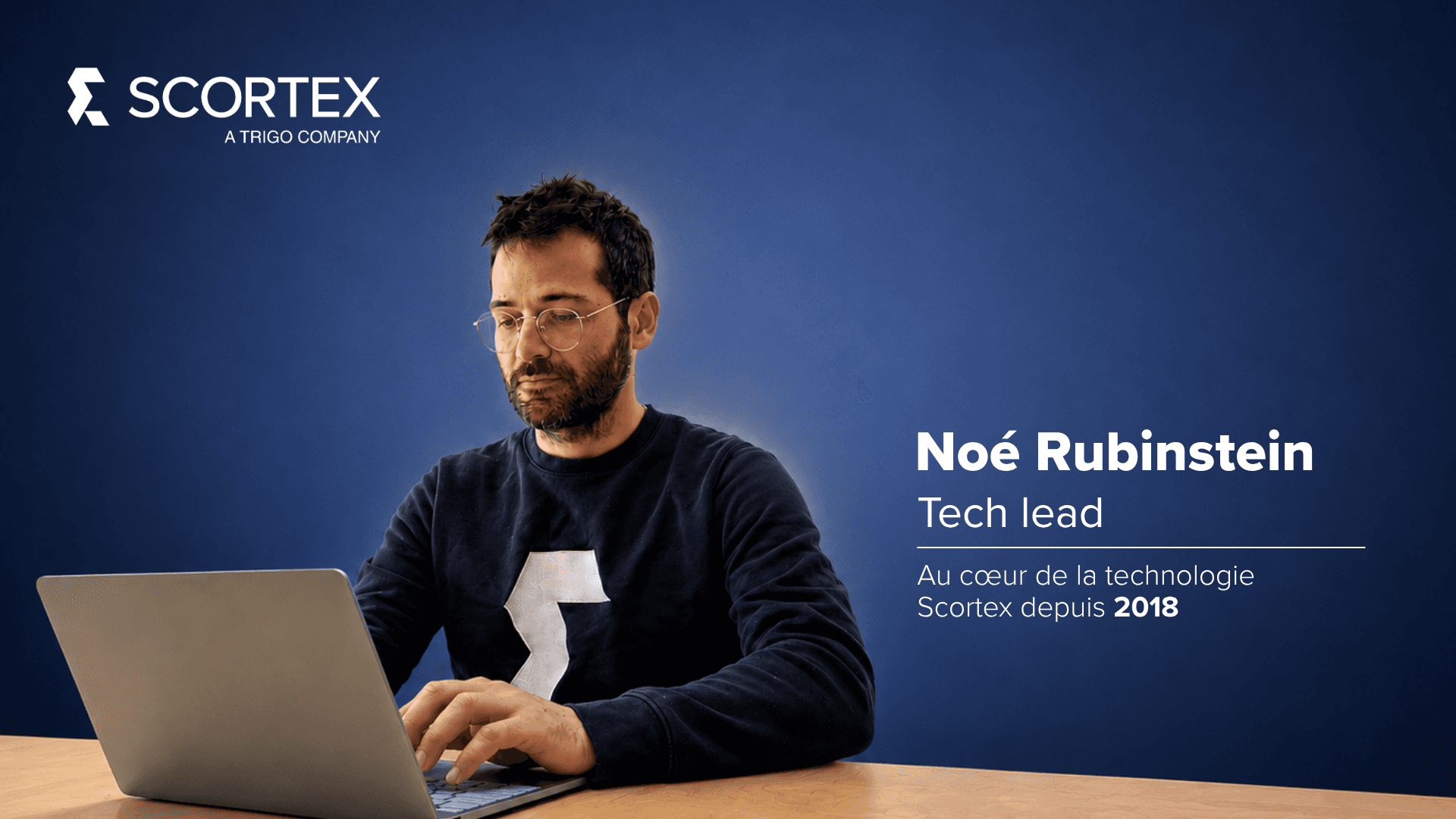
Noé Rubinstein, the engineer who bridges worlds
Noé Rubinstein, who joined Scortex in 2018, embodies this generation of engineers who have grown up with the product. Eight years spent listening to factory constraints, translating their requirements into concrete solutions, and supporting the transformation of quality control through AI.
1. When did you join Scortex and what is your role today?
I joined Scortex in 2018, as a C++ developer. At the time, I was working on the communication layer between the cameras and the inspection stations. It was a very technical role, at the heart of the system's operation.
Today, I am Tech Lead for one branch of the technical team. I support a team of four developers and act as a reference: I guide architectural choices, ensure technical consistency, and create the link between the different areas of internal expertise.
2. What does a typical day look like for you, and what are your key missions?
There isn't really a typical day. That is exactly what makes the position exciting.
My role consists primarily of creating the link between the product and the development teams. Sometimes very complex needs, expressed by the field teams or directly by customers, need to be understood and then translated into robust technical solutions.
For example, some manufacturers have to manage, on the same image, several defects of different kinds, with distinct levels of severity. Based on this requirement, we designed a feature that allows defining analysis zones and associating specific sensitivity thresholds to them.
I also participate in code reviews, architectural choices, and the evaluation of developments: what is simple, what is complex, what will take time. Support-wise, some days, I code. Other days, I dedicate myself more to coordination between the product teams and the machine learning specialists.
3. After these eight years with Scortex, what enabled the company to become a pioneer of AI applied to quality control?
I think our difference lies in our global approach. We do not just offer software or equipment: we support our customers end-to-end.
For ten years, we have been in direct contact with manufacturers. We have learned to understand their constraints, their businesses, their environments. This proximity has allowed us to build true maturity, both from a product and technical standpoint.
We have evolved with them, constantly adapting our technology to their realities. It is this capacity for continuous learning that, in my opinion, makes the difference.
4. A milestone, a unique experience to share?
A few years ago, training an AI model required a lot of data. Customers had to collect hundreds of parts, making learning cycles long and costly.
Today, the approach is entirely different. A customer can train the system themselves, in a few minutes, from a limited number of parts. They can then adjust, iterate, and test quickly.
This change has profoundly transformed the use of Spark, our quality control solution. AI has become more accessible, more agile, and above all much closer to operational needs.
5. Where has your expertise made the difference over the years?
I would say in the ability to establish dialogue between different worlds: the industrial shop floor, product constraints, and technical requirements.
Each project is a balance. You need to understand what is truly critical for the customer, avoid over-complexity, and offer a solution that is reliable, maintainable, and effective over time. It is often in these trade-offs that experience makes the difference.
6. What are you most proud of in what you have collectively built at Scortex?
Of Spark, without hesitation.
We have successfully designed a solution capable of adapting to very diverse industrial environments, with different parts, cadences, and constraints. And all this with intuitive handling.
Positive feedback from our customers is always rewarding. But the most memorable moments are those when they come back to tell us that complaints from their own customers have significantly decreased, or that certain inspections could be reduced downstream. That's when we truly measure the impact of what we are building.
7. Looking to the future, how do you see AI applied to quality control evolving?
A trend is emerging: the role of AI is gradually expanding.
Today, AI systems are often used as sorting tools, capable of distinguishing conforming from non-conforming items. In the future, they could also contribute to the analysis of observed situations.
We can imagine systems capable of identifying certain root causes, highlighting trends, or suggesting avenues for improving production processes. AI would then no longer serve solely to detect, but also to better understand what is happening on the line.
Noé Rubinstein, the engineer who bridges worlds
Noé Rubinstein, who joined Scortex in 2018, embodies this generation of engineers who have grown up with the product. Eight years spent listening to factory constraints, translating their requirements into concrete solutions, and supporting the transformation of quality control through AI.
1. When did you join Scortex and what is your role today?
I joined Scortex in 2018, as a C++ developer. At the time, I was working on the communication layer between the cameras and the inspection stations. It was a very technical role, at the heart of the system's operation.
Today, I am Tech Lead for one branch of the technical team. I support a team of four developers and act as a reference: I guide architectural choices, ensure technical consistency, and create the link between the different areas of internal expertise.
2. What does a typical day look like for you, and what are your key missions?
There isn't really a typical day. That is exactly what makes the position exciting.
My role consists primarily of creating the link between the product and the development teams. Sometimes very complex needs, expressed by the field teams or directly by customers, need to be understood and then translated into robust technical solutions.
For example, some manufacturers have to manage, on the same image, several defects of different kinds, with distinct levels of severity. Based on this requirement, we designed a feature that allows defining analysis zones and associating specific sensitivity thresholds to them.
I also participate in code reviews, architectural choices, and the evaluation of developments: what is simple, what is complex, what will take time. Support-wise, some days, I code. Other days, I dedicate myself more to coordination between the product teams and the machine learning specialists.
3. After these eight years with Scortex, what enabled the company to become a pioneer of AI applied to quality control?
I think our difference lies in our global approach. We do not just offer software or equipment: we support our customers end-to-end.
For ten years, we have been in direct contact with manufacturers. We have learned to understand their constraints, their businesses, their environments. This proximity has allowed us to build true maturity, both from a product and technical standpoint.
We have evolved with them, constantly adapting our technology to their realities. It is this capacity for continuous learning that, in my opinion, makes the difference.
4. A milestone, a unique experience to share?
A few years ago, training an AI model required a lot of data. Customers had to collect hundreds of parts, making learning cycles long and costly.
Today, the approach is entirely different. A customer can train the system themselves, in a few minutes, from a limited number of parts. They can then adjust, iterate, and test quickly.
This change has profoundly transformed the use of Spark, our quality control solution. AI has become more accessible, more agile, and above all much closer to operational needs.
5. Where has your expertise made the difference over the years?
I would say in the ability to establish dialogue between different worlds: the industrial shop floor, product constraints, and technical requirements.
Each project is a balance. You need to understand what is truly critical for the customer, avoid over-complexity, and offer a solution that is reliable, maintainable, and effective over time. It is often in these trade-offs that experience makes the difference.
6. What are you most proud of in what you have collectively built at Scortex?
Of Spark, without hesitation.
We have successfully designed a solution capable of adapting to very diverse industrial environments, with different parts, cadences, and constraints. And all this with intuitive handling.
Positive feedback from our customers is always rewarding. But the most memorable moments are those when they come back to tell us that complaints from their own customers have significantly decreased, or that certain inspections could be reduced downstream. That's when we truly measure the impact of what we are building.
7. Looking to the future, how do you see AI applied to quality control evolving?
A trend is emerging: the role of AI is gradually expanding.
Today, AI systems are often used as sorting tools, capable of distinguishing conforming from non-conforming items. In the future, they could also contribute to the analysis of observed situations.
We can imagine systems capable of identifying certain root causes, highlighting trends, or suggesting avenues for improving production processes. AI would then no longer serve solely to detect, but also to better understand what is happening on the line.
Let's discuss your quality today.
Scortex team is happy to answer your questions.
Let's discuss your quality today.
Scortex team is happy to answer your questions.

Join our newsletter
Some visuals on this site were generated using AI.
Join our newsletter
Some visuals on this site were generated using AI.