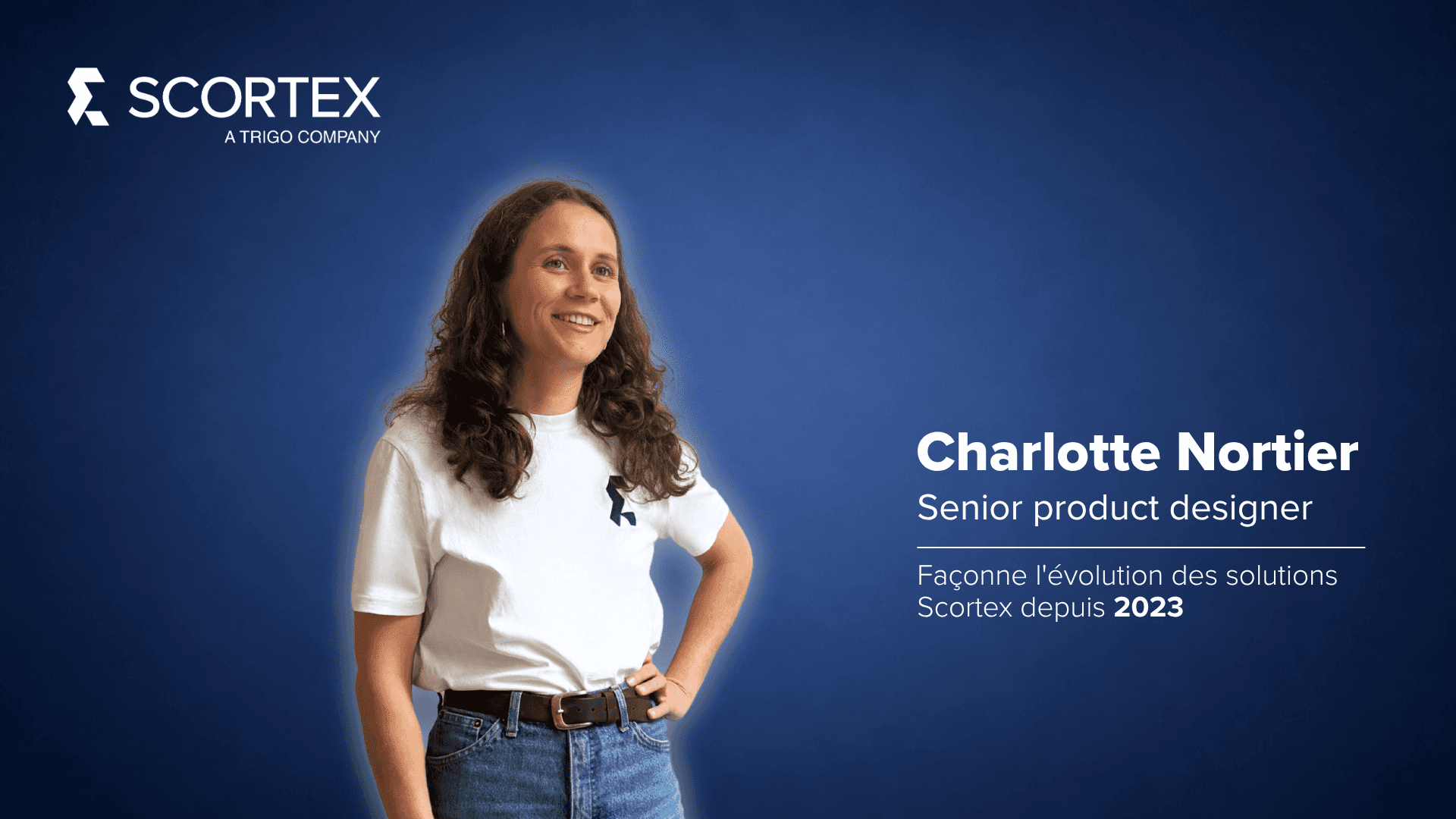
Charlotte Nortier, the art of simplifying technology
Behind every Spark or Quality Center feature lies a process of listening, design, and iteration. Since joining Scortex, Charlotte has been dedicated to making advanced technologies understandable and useful for the teams that use them on a daily basis in production plants.
1. When did you join Scortex and what is your role today?
I joined Scortex in January 2023 as a product designer, and the first to hold this position within the company. It's a responsibility that motivated me from the very start: that of structuring this role in a rapidly developing company.
Today, I am in charge of designing the user interfaces for our two products, Spark and the Quality Center. This involves working closely with Product Managers to identify user needs and product opportunities, as well as with technical teams to define together the best ways to implement these solutions.
2. What does a typical day look like for you, and what are your key missions?
There isn't really a typical day; it all depends on current projects and their progress. What structures my work is rather three main missions.
The first: the definition of problems. Everything begins with an exploration phase with Product Managers to frame the challenges, conduct user research with our customers and our internal experts, and understand exactly what is blocking.
The second: going from an idea to a concrete solution. I start by sketching ideas, then comes an iteration phase with the tech teams and Product Managers, a lot of back-and-forth, often user testing, until we end up with high-fidelity mockups, precise enough for developers to implement them without ambiguity.
The third: monitoring development. My work doesn't stop at design. I make sure that what is delivered matches what was imagined, performing numerous tests to avoid regressions and guarantee an optimal experience for our clients.
3. After nearly three years at Scortex, what do you think has allowed the company to become a pioneer of AI applied to quality control?
What strikes me first of all is the richness and complementarity of the profiles that make up the team. At Scortex, you find highly varied expertise: data science, industrial vision, product, field experience, which combine to produce truly accomplished solutions.
There is also a real depth of sector knowledge. Some people have been here since the company's beginnings and have a fine understanding of industrial realities and key quality control challenges. It's a major asset in such a demanding field.
Finally, I think Spark itself is an answer to this ambition: a product capable of adapting to highly varied use cases, regardless of the industry or the complexity of the context. This flexibility, combined with real technological rigor, is in my opinion what distinguishes Scortex in the market.
4. Where has your expertise made a difference throughout your years of experience at Scortex? A challenge, a use case, or a concrete moment to share?
My main contribution lies in the graphic dimension and interface design. Scortex made the strong choice to offer accessible and well-thought-out interfaces, which is not a given in the world of industrial tools, where users are often accustomed to unintuitive software. It is a real differentiating factor, and it is something I am particularly proud of.
But it is also a daily challenge. Spark is a highly technical product, and every new feature raises the same fundamental question: does it really belong there? And if so, how can we make it understandable for users who are not AI experts?
This requires me to constantly upgrade my skills on complex technologies that are, initially, far from my core business. It is demanding, but it is also what makes this work deeply interesting: I am, in a way, the first filter between technological complexity and the experience that the end user will have.
5. What are you most proud of in what you have built collectively?
Without hesitation: the Quality Center.
It is our online platform that allows customers to access data sent back by their inspection stations. Two years ago, we decided to completely redesign it. We started with a few key features, deliberately simple, to build a solid foundation. Then, we gradually enriched the product, based on feedback and identified needs.
Today, the Quality Center has become an essential tool, inseparable from the use of Spark. I almost find it hard to imagine how we could work without it.
What makes me proud is not just the result itself, but the trajectory: seeing a product grow consistently, feature after feature, and naturally establish itself as an obvious choice for our clients.
6. Looking ahead, how do you see AI applied to quality control evolving in the industry, and what is Scortex's place in this evolution?
AI is becoming an essential tool in almost every sector, and industrial quality control is no exception to this trend. I am convinced that its adoption will continue to become widely democratized. What was still perceived as cutting-edge technology a few years ago is progressively becoming a standard.
On the technological front, advances are constant, almost daily. This will allow us to cover ever more varied and complex use cases, and to provide answers to industrial problems that seemed difficult to address until now.
In this context, Scortex starts with a real advantage: ten years of expertise in this market. That is not municipal. It is a decade of field feedback, resolved use cases, and accumulated knowledge. A head start that will be difficult to make up for players arriving today.
Charlotte Nortier, the art of simplifying technology
Behind every Spark or Quality Center feature lies a process of listening, design, and iteration. Since joining Scortex, Charlotte has been dedicated to making advanced technologies understandable and useful for the teams that use them on a daily basis in production plants.
1. When did you join Scortex and what is your role today?
I joined Scortex in January 2023 as a product designer, and the first to hold this position within the company. It's a responsibility that motivated me from the very start: that of structuring this role in a rapidly developing company.
Today, I am in charge of designing the user interfaces for our two products, Spark and the Quality Center. This involves working closely with Product Managers to identify user needs and product opportunities, as well as with technical teams to define together the best ways to implement these solutions.
2. What does a typical day look like for you, and what are your key missions?
There isn't really a typical day; it all depends on current projects and their progress. What structures my work is rather three main missions.
The first: the definition of problems. Everything begins with an exploration phase with Product Managers to frame the challenges, conduct user research with our customers and our internal experts, and understand exactly what is blocking.
The second: going from an idea to a concrete solution. I start by sketching ideas, then comes an iteration phase with the tech teams and Product Managers, a lot of back-and-forth, often user testing, until we end up with high-fidelity mockups, precise enough for developers to implement them without ambiguity.
The third: monitoring development. My work doesn't stop at design. I make sure that what is delivered matches what was imagined, performing numerous tests to avoid regressions and guarantee an optimal experience for our clients.
3. After nearly three years at Scortex, what do you think has allowed the company to become a pioneer of AI applied to quality control?
What strikes me first of all is the richness and complementarity of the profiles that make up the team. At Scortex, you find highly varied expertise: data science, industrial vision, product, field experience, which combine to produce truly accomplished solutions.
There is also a real depth of sector knowledge. Some people have been here since the company's beginnings and have a fine understanding of industrial realities and key quality control challenges. It's a major asset in such a demanding field.
Finally, I think Spark itself is an answer to this ambition: a product capable of adapting to highly varied use cases, regardless of the industry or the complexity of the context. This flexibility, combined with real technological rigor, is in my opinion what distinguishes Scortex in the market.
4. Where has your expertise made a difference throughout your years of experience at Scortex? A challenge, a use case, or a concrete moment to share?
My main contribution lies in the graphic dimension and interface design. Scortex made the strong choice to offer accessible and well-thought-out interfaces, which is not a given in the world of industrial tools, where users are often accustomed to unintuitive software. It is a real differentiating factor, and it is something I am particularly proud of.
But it is also a daily challenge. Spark is a highly technical product, and every new feature raises the same fundamental question: does it really belong there? And if so, how can we make it understandable for users who are not AI experts?
This requires me to constantly upgrade my skills on complex technologies that are, initially, far from my core business. It is demanding, but it is also what makes this work deeply interesting: I am, in a way, the first filter between technological complexity and the experience that the end user will have.
5. What are you most proud of in what you have built collectively?
Without hesitation: the Quality Center.
It is our online platform that allows customers to access data sent back by their inspection stations. Two years ago, we decided to completely redesign it. We started with a few key features, deliberately simple, to build a solid foundation. Then, we gradually enriched the product, based on feedback and identified needs.
Today, the Quality Center has become an essential tool, inseparable from the use of Spark. I almost find it hard to imagine how we could work without it.
What makes me proud is not just the result itself, but the trajectory: seeing a product grow consistently, feature after feature, and naturally establish itself as an obvious choice for our clients.
6. Looking ahead, how do you see AI applied to quality control evolving in the industry, and what is Scortex's place in this evolution?
AI is becoming an essential tool in almost every sector, and industrial quality control is no exception to this trend. I am convinced that its adoption will continue to become widely democratized. What was still perceived as cutting-edge technology a few years ago is progressively becoming a standard.
On the technological front, advances are constant, almost daily. This will allow us to cover ever more varied and complex use cases, and to provide answers to industrial problems that seemed difficult to address until now.
In this context, Scortex starts with a real advantage: ten years of expertise in this market. That is not municipal. It is a decade of field feedback, resolved use cases, and accumulated knowledge. A head start that will be difficult to make up for players arriving today.
Let's discuss your quality today.

Scortex team is happy to answer your questions.
Let's discuss your quality today.
Scortex team is happy to answer your questions.

Join our newsletter
Some visuals on this site were generated using AI.
Join our newsletter
Some visuals on this site were generated using AI.