
Allan Koudoli, making hardware and software dialogue
Eight years after joining Scortex, Allan now leads the technical design of the product, spanning both hardware and software. His role: to transform complex industrial needs into reliable, deployable, and high-performance solutions on the production line.
When did you join Scortex and what is your role today?
It has now been eight years since I joined Scortex. Initially recruited as a VHDL (hardware description language) developer, my primary mission was to leverage the modularity and power of FPGA (field programmable gate array) platforms to optimize computation times dedicated to AI-based defect detection. Today, I hold the position of Tech Lead for one of our technical departments. Leveraging dual expertise in both Hardware and Software, I oversee our product design across both areas while managing a team composed of two developers and a mechanical engineer.
What does a typical day look like for you, and what are your key missions?
My daily routine is marked by a great diversity of missions, with no real typical day. Working in close collaboration with our Product Managers, I operate on several fronts: I translate product needs into concrete technical solutions so they can be quickly implemented by the teams, I provide my expertise to support software and hardware developments, and I occasionally assist the Customer Success team on complex projects. My central role is to support all departments in order to ensure maximum operational fluidity by removing any technical roadblocks.
After these 8 years at Scortex, in your opinion, what has allowed the company to become a pioneer in AI applied to quality control?
Our competitive advantage is built on a deep understanding of industrial quality challenges. Over the years, our collaboration with various industry players has allowed us to analyze a multitude of issues and design Spark, our automated quality control solution using AI, which is capable of responding to them effectively. We support our clients right from the definition of their quality specifications, then we deploy the vision system tailored to their parts and their quality specifications. While the end user later gains autonomy in running the software on their production line, we retain the ability to intervene remotely to help them optimize the detection performance of anomalies on their parts.
A highlight or a unique experience to share?
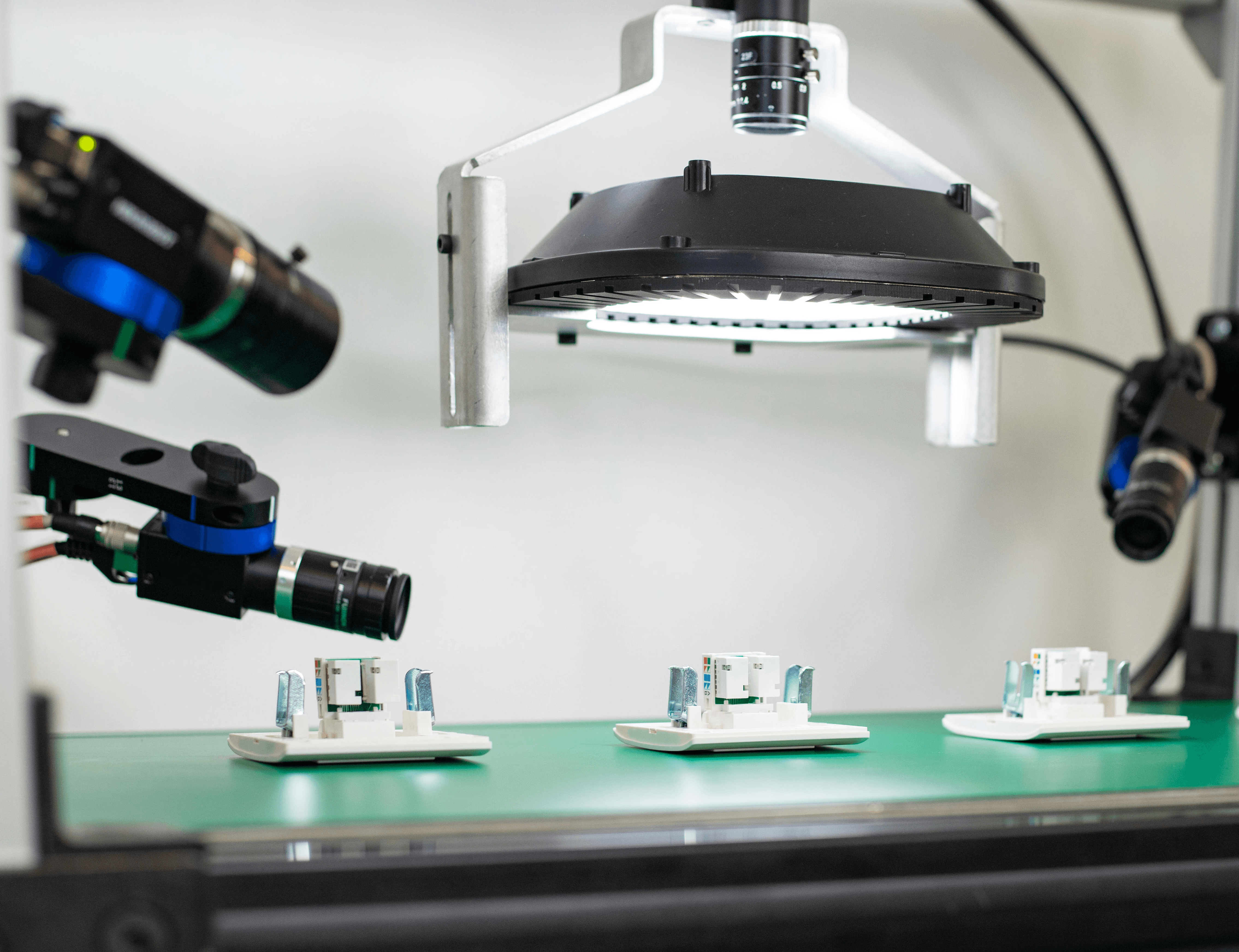
Throughout my career, I have collaborated on large-scale projects including projects for major players in the automotive industry. I have a vivid memory of one particularly striking installation: setting up a gantry equipped with a multi-camera system for inspecting aluminum parts at the output of the stamping process.
The preparatory phase of the project proved to be particularly stimulating, especially when configuring the computing unit. The deployment on site was all the more rewarding thanks to the close collaboration with the client's quality and production teams, and the final result fully met the client's expectations.
On what occasions has your expertise made a difference during your years of experience at Scortex? A challenge, a use case, or a concrete moment to share?
My determination to tackle technical issues head-on to find concrete solutions is a key driver of our strong execution capability. This commitment is demonstrated both internally, during the development of new features, and with our clients. Recently, I collaborated with the Scortex Customer Success teams on a project where detection performances did not meet the client's expectations. After a rigorous analysis of the results, I designed and tested innovative approaches that significantly improved the system's accuracy, thereby ensuring perfect alignment with the client's requirements.
What are you most proud of in what you have built collectively?
I am particularly proud of the hardware evolution carried out on the Spark Box a few years ago. By drastically simplifying the system architecture and integrating an industrial PC equipped with a cutting-edge graphics processor, we succeeded in supporting up to four cameras simultaneously. This major evolution now forms the robust foundation of our solution, enabling our software to perform inspections of parts on high-speed production lines.
Looking ahead, how do you see AI applied to quality control evolving in the industry, and what is Scortex's place in this evolution?
Quality control represents one of the final areas of industry that is still largely manual. Automating complex inspections remains a major technical challenge that often requires considerable implementation times. In my view, leveraging the quality reference standards and specifications already used on the ground by operators constitutes a major strategic lever. This would allow for pre-training or configuring inspection systems more efficiently, thus paving the way for the automation of complex processes for which no viable technical solution currently exists in production.
Allan Koudoli, making hardware and software dialogue
Eight years after joining Scortex, Allan now leads the technical design of the product, spanning both hardware and software. His role: to transform complex industrial needs into reliable, deployable, and high-performance solutions on the production line.
When did you join Scortex and what is your role today?
It has now been eight years since I joined Scortex. Initially recruited as a VHDL (hardware description language) developer, my primary mission was to leverage the modularity and power of FPGA (field programmable gate array) platforms to optimize computation times dedicated to AI-based defect detection. Today, I hold the position of Tech Lead for one of our technical departments. Leveraging dual expertise in both Hardware and Software, I oversee our product design across both areas while managing a team composed of two developers and a mechanical engineer.
What does a typical day look like for you, and what are your key missions?
My daily routine is marked by a great diversity of missions, with no real typical day. Working in close collaboration with our Product Managers, I operate on several fronts: I translate product needs into concrete technical solutions so they can be quickly implemented by the teams, I provide my expertise to support software and hardware developments, and I occasionally assist the Customer Success team on complex projects. My central role is to support all departments in order to ensure maximum operational fluidity by removing any technical roadblocks.
After these 8 years at Scortex, in your opinion, what has allowed the company to become a pioneer in AI applied to quality control?
Our competitive advantage is built on a deep understanding of industrial quality challenges. Over the years, our collaboration with various industry players has allowed us to analyze a multitude of issues and design Spark, our automated quality control solution using AI, which is capable of responding to them effectively. We support our clients right from the definition of their quality specifications, then we deploy the vision system tailored to their parts and their quality specifications. While the end user later gains autonomy in running the software on their production line, we retain the ability to intervene remotely to help them optimize the detection performance of anomalies on their parts.
A highlight or a unique experience to share?
Throughout my career, I have collaborated on large-scale projects including projects for major players in the automotive industry. I have a vivid memory of one particularly striking installation: setting up a gantry equipped with a multi-camera system for inspecting aluminum parts at the output of the stamping process.
The preparatory phase of the project proved to be particularly stimulating, especially when configuring the computing unit. The deployment on site was all the more rewarding thanks to the close collaboration with the client's quality and production teams, and the final result fully met the client's expectations.
On what occasions has your expertise made a difference during your years of experience at Scortex? A challenge, a use case, or a concrete moment to share?
My determination to tackle technical issues head-on to find concrete solutions is a key driver of our strong execution capability. This commitment is demonstrated both internally, during the development of new features, and with our clients. Recently, I collaborated with the Scortex Customer Success teams on a project where detection performances did not meet the client's expectations. After a rigorous analysis of the results, I designed and tested innovative approaches that significantly improved the system's accuracy, thereby ensuring perfect alignment with the client's requirements.
What are you most proud of in what you have built collectively?
I am particularly proud of the hardware evolution carried out on the Spark Box a few years ago. By drastically simplifying the system architecture and integrating an industrial PC equipped with a cutting-edge graphics processor, we succeeded in supporting up to four cameras simultaneously. This major evolution now forms the robust foundation of our solution, enabling our software to perform inspections of parts on high-speed production lines.
Looking ahead, how do you see AI applied to quality control evolving in the industry, and what is Scortex's place in this evolution?
Quality control represents one of the final areas of industry that is still largely manual. Automating complex inspections remains a major technical challenge that often requires considerable implementation times. In my view, leveraging the quality reference standards and specifications already used on the ground by operators constitutes a major strategic lever. This would allow for pre-training or configuring inspection systems more efficiently, thus paving the way for the automation of complex processes for which no viable technical solution currently exists in production.
Let's discuss your quality today.
Scortex team is happy to answer your questions.
Let's discuss your quality today.
Scortex team is happy to answer your questions.

Join our newsletter
Some visuals on this site were generated using AI.
Join our newsletter
Some visuals on this site were generated using AI.